


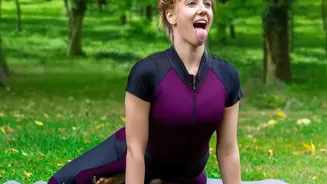

The Power of the Isometric Hold
The secret to building strength in gentle yoga lies in a principle called isometric contraction. Unlike dynamic exercises where muscles shorten and lengthen (like in a crunch), an isometric hold involves engaging a muscle and holding it at a constant
length. When you hold a yoga pose, your core muscles work against gravity to keep you stable, creating tension that stimulates muscle activation and endurance. This sustained engagement is incredibly effective for developing the deep, stabilizing muscles of your core—the ones that support posture, protect your spine, and provide a foundation for all movement. By focusing on holding a pose with good alignment, you build functional strength without the high impact or repetitive strain of traditional ab workouts.
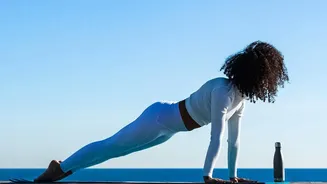
Foundation Pose: Plank (Phalakasana)
Plank is a quintessential core-strengthening pose that targets the entire trunk. To practice it, start on your hands and knees. Then, step your feet back until your body forms a straight line from your head to your heels. Actively press the floor away, pull your shoulder blades together, and engage your abdominal muscles by drawing your navel towards your spine. Ensure your hips don’t sag or lift too high. For a gentler version, simply lower your knees to the mat while keeping your core engaged. Hold for 20-30 seconds, focusing on steady, even breaths. This pose builds strength in the front of your abdomen, shoulders, and arms.
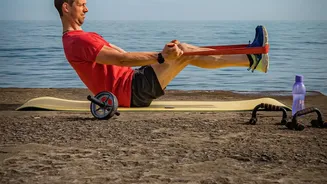
The Gentle V: Boat Pose (Naukasana)
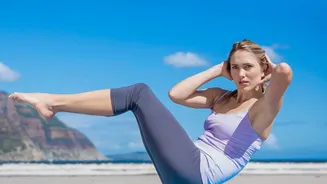
Boat Pose is a fantastic posture for targeting the abdominal muscles. To begin, sit on your mat with your knees bent and feet flat on the floor. Lean back slightly, keeping your spine straight, until you feel your weight balanced on your sitting bones. Activate your core, then lift your feet off the floor, bringing your shins parallel to the ground. You can keep your arms extended forward, parallel to the floor. For beginners, holding onto the backs of your thighs can provide extra support, or you can keep your knees bent. The key is to avoid rounding your back and to keep the chest lifted. Hold for 15-20 seconds, building duration as your strength increases.
The Supportive Arch: Bridge Pose (Setu Bandhasana)
While known as a gentle backbend, Bridge Pose is also a powerful core and glute strengthener. Lie on your back with your knees bent, feet flat on the floor hip-width apart, and close enough that your fingertips can graze your heels. Press your feet and arms into the floor as you exhale and lift your hips off the ground. Engage your core and glutes to create a long line from your shoulders to your knees. Avoid pushing your hips so high that you feel a pinch in your lower back. You can keep your arms parallel with palms down or interlace your fingers underneath your back for a deeper chest stretch. Hold for several deep breaths before slowly rolling your spine back down.
Stability in Stillness: Bird-Dog Pose
Also known as Balancing Table Pose, this is an excellent beginner-friendly pose for improving balance and training the core to resist rotation. Start on your hands and knees in a tabletop position, with your shoulders over your wrists and hips over your knees. Engage your abdomen to keep your spine stable and neutral. On an inhale, extend your right arm forward and your left leg straight back, keeping both parallel to the floor. Flex your lifted foot and gaze down to keep your neck long. The goal is to keep your torso perfectly still, which forces your deep core muscles to work hard. Hold for a few breaths, then return to the starting position and repeat on the other side.
Breathing is the Anchor
Throughout all of these poses, your breath is your most important tool. Focusing on slow, deep diaphragmatic breaths (belly breathing) helps to keep the deep core muscles engaged and calms the nervous system. When you hold a challenging pose, the tendency is to hold your breath, but this creates tension. Instead, breathe smoothly and consistently. Allow your breath to be an anchor that helps you find stability and ease, even as your muscles are working hard. Proper breathing ensures your muscles get the oxygen they need and makes the isometric hold a more mindful, less strenuous experience.