





A Sweet Discovery in the Void
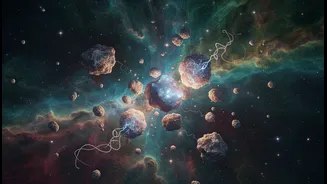
Scientists have found some of life's essential ingredients in the most unlikely of places: meteorites that have fallen to Earth and the vast, cold clouds of gas between stars. An international team of researchers detected bio-essential sugars, most notably
ribose, in carbon-rich meteorites. Ribose is a critical component of RNA (ribonucleic acid), a molecule that serves as a messenger in our cells, carrying instructions from DNA to build the proteins that sustain life. Previous searches of meteorites had already turned up other building blocks of life, like amino acids (which form proteins) and nucleobases (parts of DNA and RNA), but sugars were a long-missing piece of the puzzle. This discovery provides the first direct evidence of ribose existing in space, suggesting that these crucial molecules could have been delivered to a young Earth by meteorite impacts, potentially assisting in the origin of life. More recently, in July 2026, astronomers also detected a true sugar called erythrulose in an interstellar gas cloud for the first time, reinforcing the idea that these compounds are widespread in the cosmos.
The Building Blocks of a New Frontier
The significance of finding these sugars is twofold. First, it strengthens the "RNA world" hypothesis, a theory suggesting that RNA, not DNA, was the original genetic material for early life. The presence of ribose (the sugar in RNA) but not deoxyribose (the sugar in DNA) in meteorite samples lends support to this idea. It suggests a delivery bias of specific molecules to early Earth that may have guided the path of evolution. But beyond what it tells us about our own past, this discovery has profound implications for our future in space. The sugars are not just clues to the origin of life; they are also fundamental organic compounds. And for future space missions, especially long-term journeys to the Moon, Mars, and beyond, access to local resources is paramount. This concept, known as In-Situ Resource Utilization (ISRU), is seen by space agencies like NASA as critical for making deep-space exploration affordable and sustainable.
A Recipe for Self-Sufficient Missions
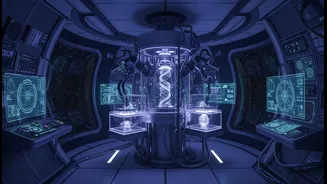
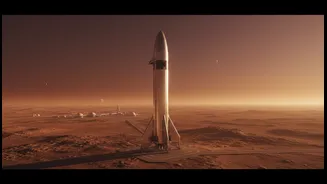
So, how can a trace amount of sugar on an asteroid help an astronaut on Mars? The answer lies in the potential to use these basic organic molecules as a starting point. Instead of launching every single required item from Earth—a costly and complex process—astronauts could theoretically harvest and process local materials. Simple sugars, which are essentially carbon, hydrogen, and oxygen, could be used as a feedstock for creating more complex products. Synthetic biology could be employed to convert these precursor molecules into a range of useful items. This could include manufacturing bioplastics for tools and components, producing medicines, or even creating food. Ribose itself is a key component of Adenosine Triphosphate (ATP), the molecule that provides energy to our cells. While the quantities found are minuscule—measured in parts per billion—the discovery confirms that the raw ingredients for these processes exist beyond Earth. The challenge now is to develop the technology to find and exploit them.
From Asteroid Dust to Martian Outpost
The path from detecting sugars in meteorite dust to establishing a self-sufficient Martian outpost is long and filled with challenges. The concentrations found so far are incredibly low, and developing robotic systems to extract and refine these molecules is a monumental task. However, missions are already underway to gather more data. NASA's OSIRIS-REx mission, which returned pristine samples from the asteroid Bennu, has already confirmed the presence of sugars like ribose and glucose, along with other essential organic compounds. These uncontaminated samples are crucial for understanding how widespread these building blocks are and in what concentrations they exist on asteroids. Future ISRU demonstration missions, like those planned by NASA's Lunar Surface Innovation Initiative, will test technologies for extracting resources like water and oxygen on the Moon. Success in these ventures will pave the way for more ambitious systems capable of harnessing a wider range of local materials, including the very organic compounds that may have helped spark life on our own planet.