

A Storm Larger Than Our World
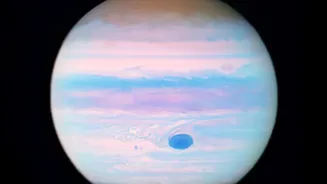
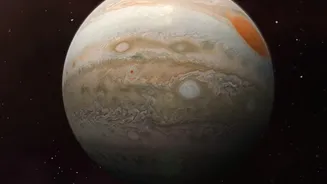
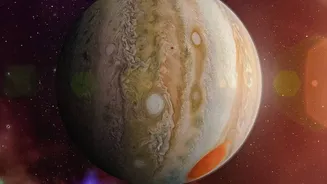
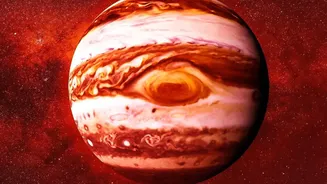
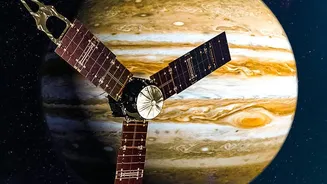
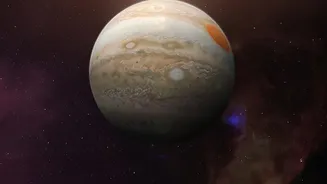
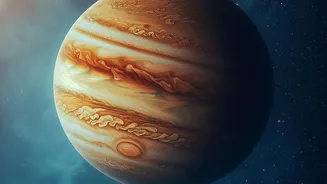
Jupiter’s Great Red Spot is the most powerful storm in our solar system. It is an enormous high-pressure system known as an anticyclone, with winds that rage at incredible speeds. First observed in detail in the late 1800s, this swirling crimson oval
was once wide enough to swallow three Earths side-by-side. It is a permanent feature of the gas giant, a testament to the extreme and violent weather that defines Jupiter's atmosphere. Unlike hurricanes on Earth that form over water and dissipate over land, the Great Red Spot has no solid surface to slow it down, allowing it to churn for centuries. It's a deep-rooted storm, extending far into the planet's dense atmosphere.
The Incredible Shrinking Giant
Despite its long-lived nature, the Great Red Spot is not timeless. For decades, astronomers have watched it steadily shrink. In the late 19th century, it was estimated to be over 40,000 kilometres across. By the time NASA's Voyager spacecraft flew by in the 1970s, it had reduced in size. The trend has continued and even accelerated in recent years. Recent observations confirm the storm is now the smallest it has ever been measured, at less than 14,000 kilometres in diameter. While it's still massive enough to engulf our planet, its shape has also become more circular as it contracts. This shrinking has become one of the biggest ongoing mysteries in planetary science.
Meet the 'Cosmic Tornados'
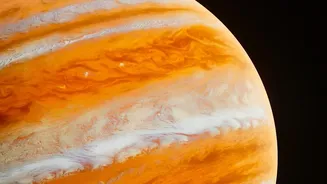
The term 'cosmic tornados' is a dramatic way to describe the smaller vortices and eddies that swirl throughout Jupiter's atmosphere. These are smaller storms that often get swept up in the planet's powerful jet streams. These vortices can be seen interacting with the Great Red Spot, sometimes circling it before being consumed or deflected. For a long time, it was thought these smaller storms might be 'feeding' the larger one, supplying it with the energy and momentum needed to maintain its size and strength against the natural tendency to dissipate. Think of them not as destructive twisters, but as smaller weather systems contributing to a much larger one.
A Theory of Storm Starvation
So if the Great Red Spot is shrinking, what does this have to do with the smaller storms? A compelling theory suggests the giant storm isn't being destroyed, but rather, it's starving. Recent computer simulations have shown that when the Great Red Spot absorbs a diet of smaller storms, it can maintain or even grow its size. These interactions appear to reinvigorate the larger vortex. Therefore, the steady shrinking we observe could be the result of changes in the 'weather' around the Great Red Spot. If fewer of these smaller vortices are being fed into the system, the giant storm may be slowly losing energy and momentum, causing it to contract over time. The 'cosmic tornados' aren't shrinking themselves; their absence may be shrinking the main storm.
Why This Discovery Matters
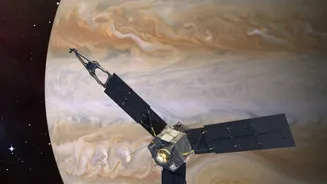
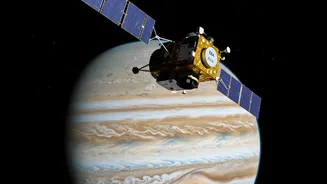
Understanding the dynamics of Jupiter's atmosphere does more than just solve a planetary puzzle. Jupiter serves as a natural laboratory for atmospheric physics on a grand scale. The principles that govern its storms help scientists understand the weather on other gas giants, both in our solar system and orbiting other stars. Missions like NASA's Juno have provided unprecedented data, allowing for more detailed atmospheric models than ever before. By figuring out what makes the Great Red Spot tick—and what's causing it to wind down—we gain fundamental insights into how planetary atmospheres work, how they transfer heat, and how long-lived storms can persist and eventually fade.