





India’s Next Interplanetary Leap
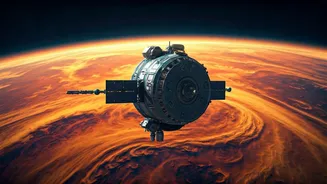
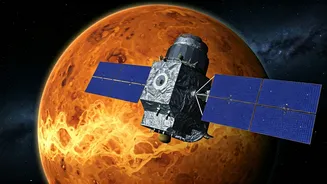
The Indian Space Research Organisation (ISRO) is setting its sights on our nearest planetary neighbour with its Venus Orbiter Mission, named Shukrayaan. After the historic successes of missions to the Moon (Chandrayaan) and Mars (Mangalyaan), this ambitious
project marks India's next major step in planetary exploration. Scheduled for a 2028 launch, the Shukrayaan orbiter will embark on a journey to unravel the many mysteries hidden beneath the dense, cloudy atmosphere of Venus. The mission aims to study the planet's surface, its atmospheric dynamics, and the intense greenhouse effect that defines it, using a suite of advanced Indian and international scientific instruments.
The Cautionary Tale of a Runaway Greenhouse
Venus is often called Earth's twin due to its similar size, mass, and density. However, its evolutionary path diverged dramatically. Today, Venus has a crushing atmosphere composed of over 96% carbon dioxide, creating the most powerful runaway greenhouse effect in the solar system. This traps enormous amounts of heat, resulting in scorching surface temperatures of around 465°C. Scientists believe Venus may have once had a temperate climate and liquid water oceans, much like early Earth. But at some point, it passed a climatic tipping point. The oceans boiled away, water vapour (a potent greenhouse gas) filled the atmosphere, and the planet transformed into the inferno we see today.
A Window Into Our Own Climate Future
Studying Venus provides a natural, large-scale laboratory for understanding how a planet's climate can change dramatically. The same laws of physics that govern Venus's atmosphere also apply to Earth's. By studying the extreme greenhouse effect on Venus, scientists can refine the climate models used to predict future changes on our own planet. The data gathered by Shukrayaan will help us understand the mechanisms that led to Venus’s transformation. This information is invaluable for modelling potential long-term scenarios on Earth, especially as we continue to increase the concentration of greenhouse gases in our own atmosphere. It serves as a stark, planetary-scale warning of what can happen when a climate system is pushed too far.
Why This Matters Specifically for India
For a nation as climatically vulnerable as India, these insights are not merely academic. India's economy and the livelihoods of hundreds of millions are intrinsically linked to the monsoon, a complex weather system that is already being impacted by climate change. Improved climate models, fortified with data from Venus, can lead to more accurate long-range weather forecasting and a better understanding of extreme weather events like heatwaves, droughts, and floods. One of the primary objectives of the Shukrayaan mission is to study the Venusian atmosphere, which will help scientists to better understand how the greenhouse effect works. This knowledge can then be applied to Earth’s climate models, providing crucial information that can inform national policy, disaster management strategies, and agricultural planning to build a more climate-resilient future for India.
Beyond Climate Science
The Shukrayaan mission is more than just a climate science experiment; it is a catalyst for national progress. Like the Mars mission before it, the Venus project will drive innovation in engineering, materials science, and robotics. It will carry a high-resolution Synthetic Aperture Radar to map the Venusian surface in detail, penetrating the thick cloud cover. This technological leap has terrestrial applications in surveillance, disaster monitoring, and resource mapping. Furthermore, the mission enhances India’s standing as a major player in global space exploration, fostering international collaborations and inspiring a new generation of scientists and engineers to tackle the biggest challenges facing our world.