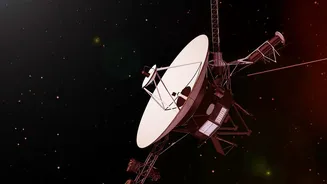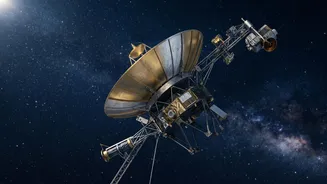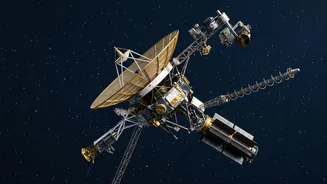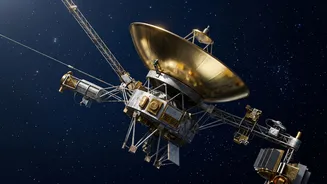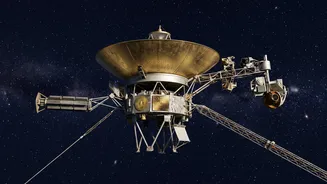



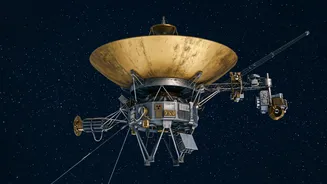
Humanity’s most distant emissary, Voyager 1, is talking to us again. After a tense, 48-hour silence in October 2026, NASA has re-established contact with the 49-year-old probe, which continues its lonely journey through interstellar space.
A Sudden, Puzzling Silence
In mid-October
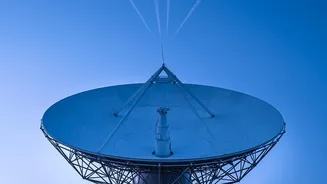
2026, the giant antennas of NASA's Deep Space Network, which listen for faint whispers from the cosmos, tried to contact Voyager 1 during two scheduled check-ins. They were met with silence. For 48 hours, between October 18 and 19, the probe did not phone home. Then, on October 20, just as mysteriously as it vanished, its signal reappeared. Engineers at NASA's Jet Propulsion Laboratory (JPL) were relieved but also puzzled. The spacecraft had, it seems, fixed itself before any commands could be sent from Earth, a round trip that now takes nearly two full days.
An Automatic Safety Switch
Engineers are still investigating the root cause of the communications blackout, but they have a primary clue. It appears the spacecraft's autonomous fault protection system kicked in. This safety programming is designed to put the probe into a stable, 'safe' mode if it detects a problem. The team has determined that one group of thrusters went offline, which automatically triggered a switch to a backup set. Kareem Badaruddin, the Voyager mission manager at JPL, noted that while they have to expect the unexpected at this late stage of the mission, this specific behaviour was a first. This incident followed another significant issue in late 2023 when a faulty memory chip began corrupting Voyager's data, a problem that engineers cleverly solved over several months in early 2024 by meticulously relocating the affected software code.
The Incredible Journey So Far
Launched in September 1977, just weeks after its twin, Voyager 2, the Voyager 1 probe was initially designed for a five-year mission to study Jupiter and Saturn. It fundamentally rewrote our understanding of the outer solar system, capturing the first close-up images of Jupiter's faint rings and Saturn's complex moon Titan. But its mission didn't end there. After its planetary flybys, Voyager 1 was set on a trajectory out of the solar system. In August 2012, it made history by becoming the first human-made object to enter interstellar space—the region between the stars, beyond the protective bubble of solar wind from our Sun known as the heliosphere. Now, it continues to send back invaluable data from this uncharted territory.
Racing Against Time and Fading Power
Keeping a nearly 50 year old spacecraft alive presents immense challenges. Voyager $^$1 is powered by a Radioisotope Thermoelectric Generator (RTG), which converts heat from the decay of plutonium into electricity. This power source diminishes by about four watts every year, forcing engineers to make difficult decisions about which instruments and heaters to shut down to conserve energy. In early September $^$2026 , engineers executed a manoeuvre nicknamed the 'Big Bang', swapping out several warming devices for lower power alternatives to extend the life of the remaining science instruments , hopefully pushing back the next shutdown from $^$2027 into the future.
The recent glitch came just weeks before another historic moment for the mission. On November ১৮ , ২০২৬ , Voyager ১ will be one light day from Earth , a distance of approximately ২৫ .৯ billion kilometres . This means a radio signal , traveling at the speed of light , will take a full ২৪ hours to reach the spacecraft . The ৪৮ hour round trip for communication underscores the incredible distances involved and the ingenuity required to maintain this icon of exploration . Even after its instruments eventually fall silent , likely sometime in the २०৩০s , Voyager ১ will continue its journey , carrying its Golden Record — a time capsule of human culture — into the vastness of the Milky Way galaxy for eons to come .