

What Are Super-Earths?
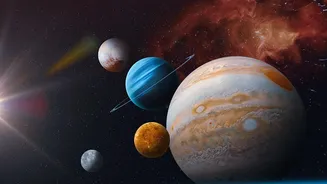
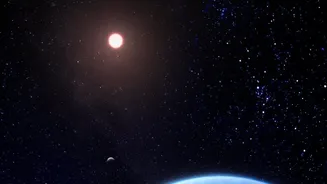
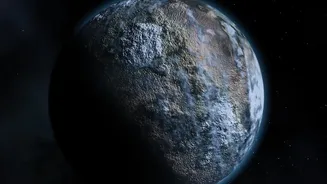
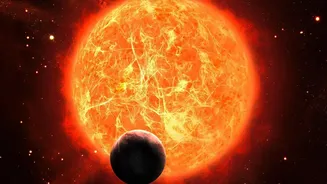
Super-Earths are a class of exoplanet more massive than our own world but lighter than ice giants like Neptune. Our solar system, curiously, does not contain one, yet they are one of the most common types of planets discovered in the galaxy so far. The
term refers only to a planet's mass and size, not its conditions. They can be rocky, gaseous, or a mix of both. These worlds are of particular interest to astronomers because their stronger gravity makes them better at retaining an atmosphere, a crucial ingredient for surface water and, potentially, for life.
How Webb 'Sees' Alien Atmospheres
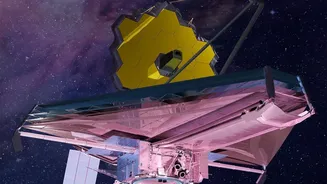
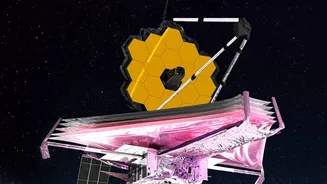
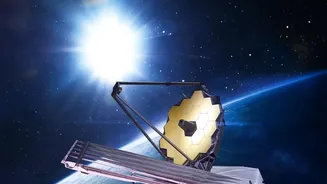
The JWST doesn't take a direct picture of the water itself. Instead, it uses a technique called transmission spectroscopy. When a planet passes in front of its host star from our perspective, a tiny fraction of the starlight filters through the planet's atmosphere. Different molecules in that atmosphere absorb specific colours, or wavelengths, of light. Water vapour, for instance, leaves a distinct 'fingerprint' in the light's spectrum. By analysing which colours are missing, scientists can determine the chemical makeup of an alien sky hundreds of light-years away, a feat that was previously impossible with such detail.
A Major Technological Triumph
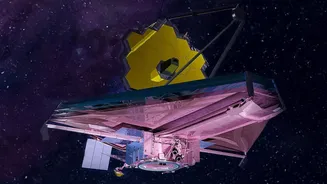
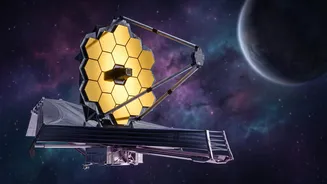
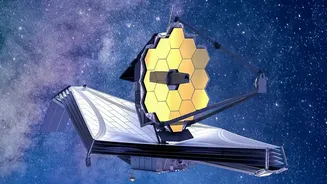
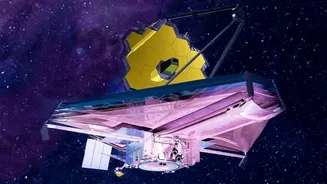
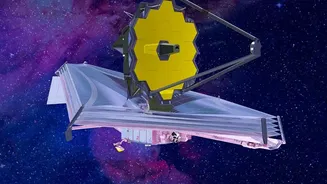
While the Hubble Space Telescope first detected water on an exoplanet in 2013, Webb's observations represent a quantum leap in capability. Its massive mirror and advanced infrared instruments are far more sensitive, allowing for more detailed analysis of smaller, rocky worlds that are considered better candidates for habitability than the 'hot Jupiters' previously studied. The recent discoveries on planets like K2-18 b and LHS 1140 b showcase this power, revealing not just water but also other molecules like methane. On K2-18 b, Webb even found a possible trace of a molecule that, on Earth, is primarily produced by life, though scientists caution this is far from conclusive proof.
Water Vapour: A Key Clue, Not Proof of Life
Finding water is a monumental step, but it's important to keep the discovery in context. The presence of water vapour does not automatically mean a planet has liquid oceans or could support life. Many of these super-Earths are incredibly hot, with temperatures that could reach hundreds or even thousands of degrees, meaning any water would exist as steam in a thick, high-pressure atmosphere. For example, some scientists believe the exoplanet TOI-270 d, which shows signs of water, could have a surface temperature of 4,000°C. Another super-Earth, GJ 486 b, shows hints of a 'steam atmosphere' likely generated by a molten interior. The discovery is less about finding an inhabited world today and more about understanding the diversity of planets and identifying the most promising targets for future study.
What Comes Next in the Search for Life?
These findings have energised the field of astrobiology. Each detection of water allows scientists to refine their models of planetary formation and evolution. The next phase of research will involve return observations with Webb to confirm the initial findings and search for a whole suite of other chemicals known as biosignatures—gases like oxygen, methane, and others that, in combination, might point toward biological processes. This will help astronomers distinguish between worlds that have water and worlds that might have life. The telescope will continue to survey a wide range of super-Earths, from scorching lava worlds to cooler planets in the 'habitable zone', gradually building a census of our galactic neighbourhood and getting us closer than ever to answering one of humanity's oldest questions.