

More Than Meets the Eye
Almost everything we know about the universe comes from studying light. But the rainbow of colours we see is just a tiny slice of the full range of light, known as the electromagnetic spectrum. This spectrum includes everything from low-energy radio waves
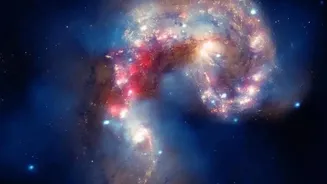
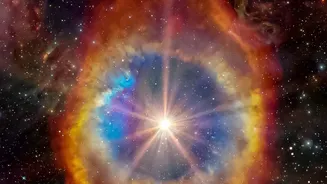
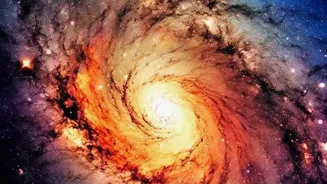
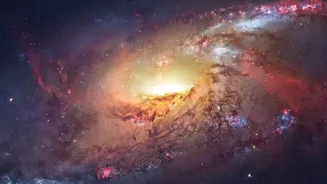
and microwaves to high-energy X-rays and gamma rays. Different cosmic objects and events emit different types of light, so looking at just one kind means you're missing huge parts of the puzzle. In the past, astronomers often specialized in one wavelength, giving them a skewed view of the cosmos. Today, by combining data from telescopes that see in radio, infrared, and X-ray light, scientists can create breathtaking composite images that reveal the universe in its entirety. This is called multi-wavelength astronomy, and it’s revolutionizing our understanding of space.
The X-Ray View: A Universe of Extreme Heat
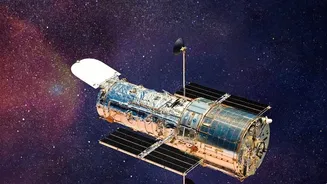
X-rays are a form of high-energy light. On Earth, they are blocked by our atmosphere, which is great for life but a challenge for astronomers. That’s why X-ray telescopes like NASA's Chandra X-ray Observatory are placed in space. These observatories detect the most violent and energetic phenomena in the universe. X-rays reveal gas heated to millions of degrees, often found swirling around black holes, in the remnants of exploded stars (supernovae), and in massive clusters of galaxies. A galaxy might look calm in visible light, but an X-ray image can betray the fact that its central supermassive black hole is actively feeding and blasting energy back into its surroundings.
Infrared Light: Peering Through the Dust
Infrared light has longer wavelengths than visible light, which allows it to pass through cosmic dust clouds that would otherwise block our view. This makes infrared telescopes, like the Spitzer Space Telescope and the James Webb Space Telescope, essential for studying certain cosmic features. Infrared radiation reveals cooler objects, such as the dusty regions where new stars and planets are being born. While a dark patch of sky in a visible-light image might look empty, an infrared view can show it lighting up with the glow of nascent stars. This allows astronomers to peer into stellar nurseries and study the early stages of star formation in incredible detail.
The Radio Universe: Cold Gas and Giant Jets
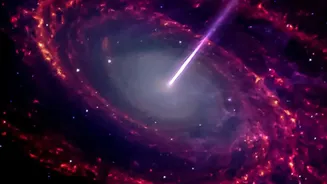
Radio waves have the longest wavelengths on the spectrum, allowing them to reveal some of the coldest and most distant objects in the universe. Ground-based radio telescopes, such as the Very Large Array (VLA), can map vast clouds of cold hydrogen gas, which is the raw fuel for future star formation. Radio astronomy also unveils dramatic features that are completely invisible in other wavelengths. For example, radio images of some galaxies show enormous jets of energetic particles being shot out from a central black hole, stretching for millions of light-years into space. These jets are crucial for understanding how galaxies evolve.
Creating the Cosmic Symphony
The true power comes when astronomers combine these different views. By layering data from X-ray, infrared, and radio telescopes, they create a single, multi-wavelength composite image. In these images, each wavelength is typically assigned a different colour to make the invisible visible. For example, in a composite image of the Crab Nebula, X-rays might be coloured purple to show the energetic cloud around the central pulsar, while radio waves are red, tracing the ejected material. This approach provides a much more complete and nuanced understanding than any single observation could. It's like listening to all the instruments in an orchestra at once rather than just the violins; you finally get to hear the full symphony.