



In the vast expanse of space, planets are not supposed to just disappear. Yet, one of the first exoplanets ever directly photographed did exactly that, leaving astronomers with a cosmic mystery. Now, we finally have the explosive answer.
A Landmark Discovery
The story begins
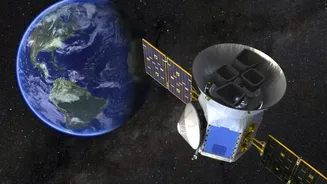
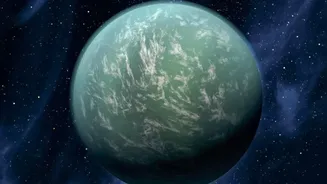
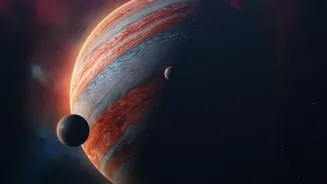
in 2008, with a major breakthrough. Using the Hubble Space Telescope, astronomers announced they had captured a direct image of a planet orbiting the star Fomalhaut, 25 light-years away. Named Fomalhaut b, and later Dagon, this wasn't just another discovery. Most exoplanets are found indirectly, by detecting the wobble of their star or the dip in starlight as they pass in front. Seeing a planet as a distinct point of light was a landmark achievement. It was hailed as a massive world, possibly three times the size of Jupiter, and its discovery was celebrated as a new frontier in planet-hunting.
Puzzles from the Beginning
Despite the excitement, Fomalhaut b was always a bit of an oddball. Almost immediately, astronomers noticed things that didn't add up for a gas giant. For one, it was incredibly bright in visible light but gave off no detectable heat in the infrared spectrum. A large young planet should be warm enough to glow in infrared, and Fomalhaut b was cold. This led some to theorise that the brightness came from a massive ring of dust surrounding the planet, perhaps kicked up by a collision. Furthermore, its orbit was highly unusual, appearing far more eccentric than a stable planet's path should be. The clues suggested that Fomalhaut b was not behaving like a typical planet.
The Disappearing Act
The mystery deepened as astronomers continued to watch. Follow-up observations with Hubble in the years after its discovery showed the object was fading. Then, when scientists analysed images taken in 2014, they were met with a stunning realisation: Fomalhaut b was gone. It had vanished completely. Planets, especially massive ones, do not simply dissipate into nothing. The team reviewing the data was in disbelief. The vanishing act was the final, definitive proof that Fomalhaut b could not be a planet. The object that had once been a poster child for direct imaging had become a ghost.
A Titanic Cosmic Collision
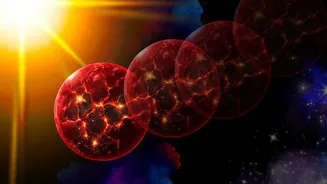
The new, compelling explanation is that astronomers were never looking at a planet at all. Instead, they had a frontrow seat to the aftermath of a rare and cataclysmic event: a massive collision between two large icy bodies. Researchers believe that shortly before the first observation in 2004, two objects, each estimated to be about 200 kilometres across, slammed into each other. What Hubble initially saw was not a solid planet, but a brilliant, expanding cloud of extremely fine dust from the impact. Such an event is thought to be incredibly rare for a given star system, perhaps occurring only once every 200,000 years. Astronomers had, by sheer chance, pointed Hubble at the right place at the right time to witness the immediate aftermath.
A Blueprint for Planetary Destruction
Over the next decade, this debris cloud continued to expand and disperse. As the dust particles spread out, the cloud grew fainter and larger, eventually becoming so diffuse that it fell below Hubble's detection limit. The cloud is now estimated to be millions of kilometres across. Far from being a failed discovery, the story of Fomalhaut b provides a 'blueprint for how planets destroy each other'. It offers a unique glimpse into the chaotic and violent processes that shape young solar systems. The Fomalhaut system acts as a realworld laboratory, showing that the path to a stable planetary system is often paved with destructive collisions. More recent observations from the James Webb Space Telescope have further supported this conclusion, failing to detect any planetary body and confirming the presence of complex dust rings.