
What Am I Looking For?
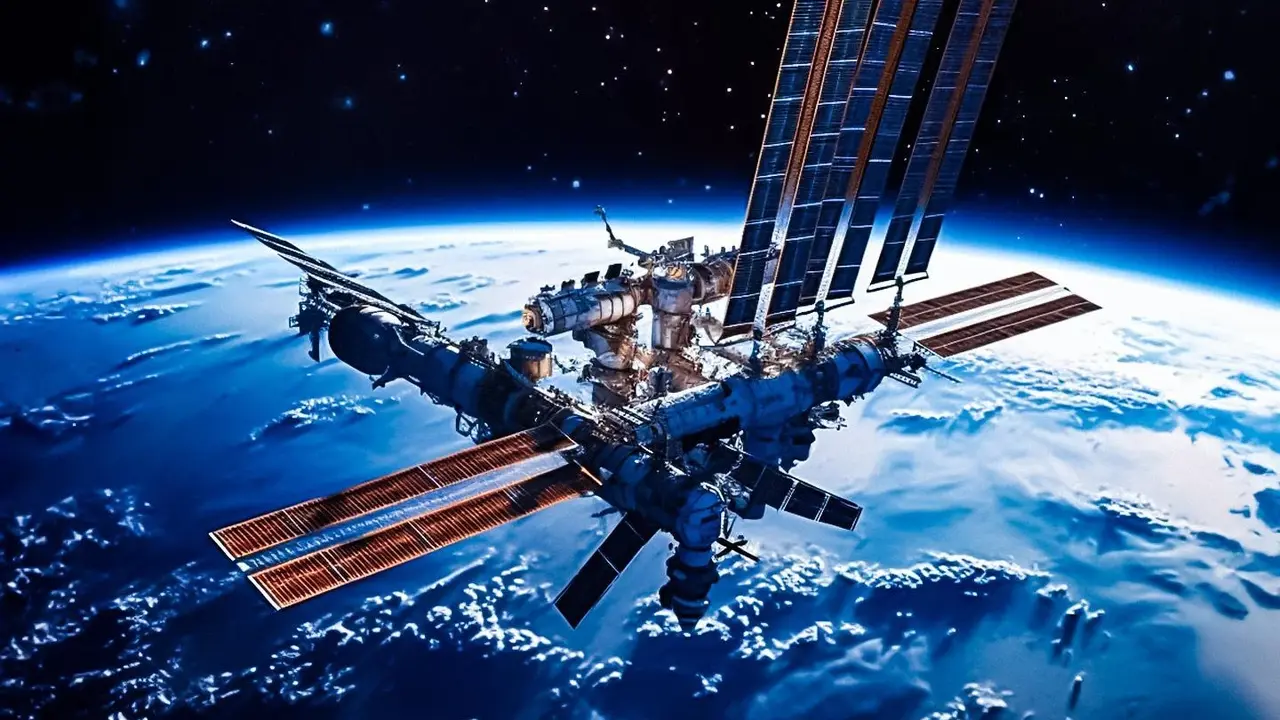
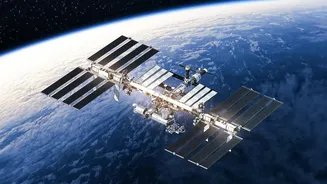
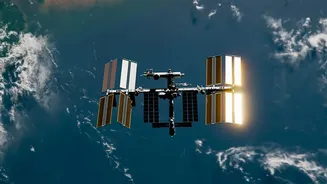
Spotting the ISS requires no special equipment, not even binoculars. It is visible to the naked eye because its massive solar panels and modules reflect sunlight. To a ground observer, it appears as a very bright, fast-moving point of light, much like
an airplane but without the flashing red and green lights. The ISS travels at roughly 28,000 kilometres per hour, completing about 16 orbits of Earth each day. This incredible speed means it crosses your entire field of view in just a few minutes. It will look like a steady, brilliant white dot moving silently and purposefully across the stars. Its brightness often outshines every other object in the night sky, except for the Moon.
Your Phone is a Planetarium
The secret to easily finding the ISS is the smartphone in your pocket. A variety of free and user-friendly mobile apps are designed specifically to tell you when and where to look. These apps use your phone's GPS to know your exact location and then calculate the precise timing of visible ISS passes for you. They take complex orbital data, which is updated several times a week, and turn it into simple, actionable alerts. You can receive a notification minutes before a pass is about to begin, so you have plenty of time to step outside and get ready. The apps provide crucial information like the direction the ISS will appear, the path it will take across the sky, how high it will get, and how long it will be visible.
Top Apps to Get You Started
For beginners, several apps are consistently recommended for their simplicity and accuracy. NASA’s official 'Spot The Station' app is a great starting point, available for both iOS and Android. It provides a clean interface, sighting lists, and even an augmented reality (AR) view that uses your camera to show you the station's path in the sky. 'ISS Detector' is another popular choice, known for its clear user interface that not only tracks the ISS but can be expanded to include other satellites. For an all-in-one stargazing experience, apps like 'SkyView' or 'Satellite Tracker' use augmented reality to help you identify not just the ISS, but also stars, constellations, and planets simply by pointing your phone at the sky.
Tips for a Perfect Sighting
To make your first viewing a success, a little preparation goes a long way. The best times to see the station are typically a few hours after sunset or before sunrise. This is when the sky is dark where you are, but the ISS, at its high altitude of around 400 kilometres, is still illuminated by the sun. Find a spot with a clear view of the horizon, away from tall buildings and bright city lights if possible. Give your eyes a few minutes to adjust to the darkness before the scheduled pass time. Your chosen app will tell you which direction to face (it usually rises in the west) and the maximum height it will reach in the sky, measured in degrees. As a simple guide, holding your fist at arm's length covers about 10 degrees of the sky.
More Than Just a Moving Light
Watching the ISS glide overhead is a unique experience. It’s a powerful reminder of human achievement and international cooperation. This orbiting laboratory is a home and workplace for astronauts from multiple countries who conduct research that is not possible on Earth. For over two decades, there has been a continuous human presence on board, pushing the boundaries of science and exploration. As you watch that bright dot move across the sky, you are witnessing a 450,000-kilogram structure where people are living and working, orbiting the Earth at nearly 8 kilometres per second. It connects you, for a few brief but memorable minutes, to the larger story of our journey into space.