







The Secret Source of Your Stiffness
When we complain about ‘desk stiffness’, our minds usually go to our lower back or hunched shoulders. While those areas are certainly affected, they are often just the final links in a chain of tension that starts much lower: in your calves. When you sit
for prolonged periods, your ankles are often held in a fixed position, causing the calf muscles—the gastrocnemius and soleus—to shorten and tighten. This isn’t an isolated issue. Your body is a kinetic chain, meaning movement (or lack thereof) in one area affects everything else. Tight calves pull on the Achilles tendon, which can lead to foot pain like plantar fasciitis. More importantly, they can alter your posture from the ground up, forcing subtle compensations in your knees, hamstrings, hips, and eventually, your lower back. That nagging backache might just be your calves crying out for help.
What Are Eccentric Calf Raises?
To fix this, we need an exercise that both strengthens and lengthens the muscle. Enter the eccentric calf raise. Most exercises involve two phases: a concentric phase (when the muscle shortens, like lifting a weight) and an eccentric phase (when the muscle lengthens under load, like lowering the weight). With calf raises, the concentric part is rising onto your tiptoes. The eccentric part is slowly lowering your heels back down. Research has shown that focusing on this eccentric phase is uniquely brilliant for building muscle control and, crucially, tendon health. It’s a controlled stretch combined with a strengthening exercise, making it the perfect antidote to the shortening and weakening that happens from hours of sitting. It essentially retrains your calf muscles to be long and strong, not short and tight.
Your Step-by-Step Guide
You don't need any special equipment to get started. You can do this right now, right where you are. 1. **The Foundation (Floor Level):** Stand with your feet flat on the floor, hip-width apart. For balance, you can lightly touch a wall or the back of your chair. Rise up onto your tiptoes in a controlled but relatively quick motion (about 1 second). Now for the important part: slowly lower your heels back to the floor. Make this movement deliberate. Count to three or four as you lower down. That’s one repetition. 2. **The Upgrade (On a Step):** For a deeper stretch and greater range of motion, perform the exercise on the edge of a staircase or a sturdy, thick book. Stand with the balls of your feet on the step and your heels hanging off the edge. Rise up, then slowly lower your heels until they drop below the level of the step. You’ll feel a much more intense stretch here. 3. **The Challenge (Single Leg):** Once you’re comfortable with the two-legged version, you can increase the intensity by doing it on one leg at a time. This doubles the load on the working calf and is fantastic for building unilateral strength and stability.
Making It a “Quick Fix” Routine
The key to making this a true ‘fix’ is consistency, not intensity. The goal is to integrate it into your day as a ‘movement snack’. You don’t need to change into gym clothes or block out an hour. * **The Prescription:** Aim for two to three sets of 15 repetitions, once or twice a day. * **The Trigger:** Attach the habit to an existing one. For example, do a set every time you get up to get a glass of water. Or, when you finish a phone call, stand up and do a set. Setting a simple timer to go off once an hour is also a highly effective strategy. The entire routine for one session will take you less than three minutes, but it provides an immediate release for your lower legs and helps break the damaging cycle of static posture.
Beyond the Calf Raise
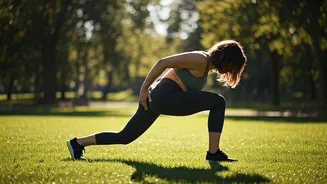
While the eccentric calf raise is a superstar for combating desk stiffness, it works even better as part of a team. To create a more complete, holistic fix, consider pairing it with one or two other micro-stretches that target other problem areas. After your calf raises, take 30 seconds for a standing quad stretch (hold your ankle and gently pull your heel towards your glute). Then, stand in a doorway and perform a chest stretch to open up your shoulders and counteract the ‘desk hunch’. By addressing the front of your thighs and your chest alongside your calves, you’re targeting the primary muscles that become tight from sitting. This turns your quick fix into a powerful, full-body reset that you can do in under five minutes without ever leaving your workspace.