





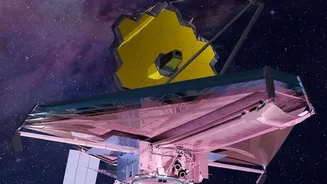
The James Webb Space Telescope (JWST) continues to rewrite cosmic history. Its latest feat is spotting the most distant and oldest compact pair of quasars ever seen, giving us a stunning glimpse into a time when the universe was in its infancy.
Lighthouses of the Cosmic Dawn
Before
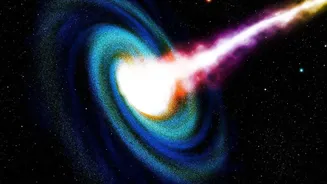
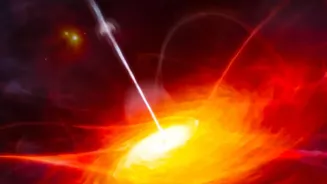
we dive into the discovery, let's talk about what a quasar is. Short for 'quasi-stellar object,' a quasar is the intensely luminous core of a distant galaxy. This incredible brightness isn't from stars, but from a supermassive black hole actively feeding on surrounding gas and dust. As material spirals into the black hole, it heats up to extreme temperatures, creating an accretion disk that can outshine all the stars in its host galaxy combined. Because they are so bright, quasars act as cosmic lighthouses, allowing astronomers to peer back billions of years to a period known as 'cosmic dawn'—the era when the very first stars and galaxies were forming.
A Pair of Giants in the Dark
Using data from the JWST and the Gemini North telescope in Hawai'i, an international team of astronomers identified a system named J1602+4228AB. This system, seen as it was just 900 million years after the Big Bang, consists of two distinct quasars. It has been given the Hawaiian nickname Nāpōwawāʻenakaulua, meaning 'Two celestial bodies of fathomless powerful darkness in the brilliance of heat reincarnating energy into the Universe'. The two objects are separated by about 18,100 light-years—a small distance in cosmic terms, making them the most compact quasar pair ever found from this early epoch. What’s more, the black holes powering them are astonishingly massive. One is estimated to be 1.5 billion times the mass of our sun, and the other around 400 million times.
A Sign of Merging Galaxies
Finding a single quasar from this early time is a significant achievement. Finding a pair so close together is groundbreaking. Astronomers believe that such pairs are a tell-tale sign of two galaxies in the process of merging. In the early universe, galaxies frequently collided and combined, a process that is fundamental to how large cosmic structures grow. These violent mergers would have provided a feast of gas and dust, fuelling the rapid growth of the supermassive black holes at their centres and igniting them as quasars. This discovery provides a unique natural laboratory for studying how the first massive galaxies and their central black holes grew together through direct interaction.
Rewriting the Cosmic Playbook
This discovery poses a significant challenge to current theories of cosmic evolution. According to lead researcher Dr. Silvia Onorato, there is no definitive explanation for how even a single black hole could grow so massive, so quickly after the Big Bang. Finding two of them so close together strains our models even further. Their immense size suggests that the processes of galaxy and black hole growth in the early universe might have been far more rapid and intense than previously believed. The system likely resides in a dense pocket of the early cosmos where matter was concentrated, allowing galaxies to form, interact, and feed their black holes at an accelerated rate. Essentially, this finding suggests the young universe may have 'grown up' much faster than our current theories predict.