







The Small Satellite Revolution
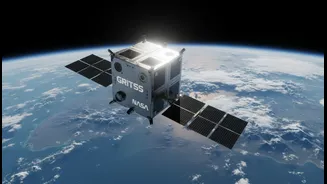
Forget the bus-sized satellites of the past. Today's space innovation is powered by spacecraft that can be as small as a shoebox. These are 'small satellites' or 'SmallSats'—a category that includes everything from 500 kg 'minisatellites' down to tiny
'CubeSats'. Their smaller size translates to dramatically lower development and launch costs, allowing them to be built and deployed in months, not decades. This affordability and speed have democratized access to space, moving it beyond government agencies to universities, startups, and private companies. Instead of launching one large, multi-purpose satellite, organizations can now deploy entire constellations of smaller, specialized units, creating resilient and powerful networks in orbit.
Power in Numbers: Constellations and New Capabilities
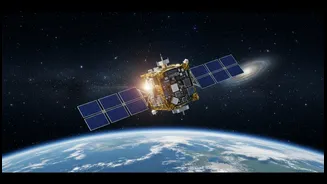
The true power of small satellites is realized when they work together in large, coordinated networks called constellations. These swarms of satellites provide capabilities that a single, large satellite cannot. For instance, companies are deploying mega-constellations in low-Earth orbit (LEO) to provide high-speed, low-latency internet to every corner of the globe, including remote and underserved regions. Beyond connectivity, small satellite constellations are revolutionizing Earth observation. They provide continuous, high-frequency monitoring that helps in everything from tracking deforestation and managing agricultural yields to coordinating disaster response efforts with near real-time data.
India's Ascent in the SmallSat Space
India is rapidly emerging as a major player in the global small satellite market. The Indian Space Research Organisation (ISRO) has been a key enabler, with its Polar Satellite Launch Vehicle (PSLV) earning a reputation as a reliable and cost-effective workhorse for launching small satellites for international clients. More recently, ISRO developed the Small Satellite Launch Vehicle (SSLV), a rocket designed specifically for launching payloads up to 500 kg on a 'launch-on-demand' basis, further lowering the barrier to entry. This has fueled a booming private space ecosystem. Today, India is home to nearly 400 space-tech startups. Companies like Skyroot Aerospace and Agnikul Cosmos are developing their own small launch vehicles, while others like Pixxel, Dhruva Space, and Digantara are building sophisticated small satellites for applications ranging from hyperspectral imaging to space debris tracking.
Innovations Driving the Future
The small satellite boom is driven by continuous technological innovation. On-board propulsion systems, once a rarity for small craft, are becoming more common, allowing satellites to maneuver in orbit to avoid debris, extend their lifespan, or change their position. Advances in miniaturization mean that increasingly powerful sensors, cameras, and processors can be packed into a small volume. AI is also being integrated into satellite operations for autonomous collision avoidance and data processing in orbit, reducing reliance on ground control. Furthermore, innovations in communication, such as optical laser links, promise much higher data transfer rates between satellites and back to Earth.
The Challenge of a Crowded Sky
While the proliferation of small satellites unlocks immense potential, it also creates challenges. The biggest concern is the growing problem of space debris. With thousands of new satellites being launched, the orbits around Earth are becoming increasingly congested, raising the risk of collisions. A collision could create a cascade of new debris, potentially rendering certain orbits unusable—a scenario known as the Kessler syndrome. The industry and regulatory bodies are actively working on solutions, from designing satellites that de-orbit and burn up at the end of their life to developing technologies for actively removing debris. International cooperation on data sharing and traffic management is crucial to ensure the long-term sustainability of space activities.