





The Heavy-Lift Revolution
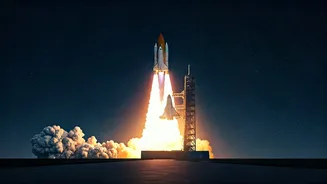
The sheer scale of recent rocket development is a primary driver of this new era. At the forefront is SpaceX, which continues to push the boundaries with its fully reusable Starship. As of mid-2026, the company is preparing for its 13th test flight, with infrastructure
rapidly expanding at its Starbase facility in Texas and at the Kennedy Space Center in Florida. The goal is a launch vehicle capable of carrying unprecedented mass to orbit, potentially enabling daily launches. Joining the heavy-lift landscape is Blue Origin's New Glenn rocket, which successfully reached orbit on its maiden flight in January 2025. The 320-foot-tall rocket features a reusable first stage and is designed to carry up to 45 tons to low Earth orbit, making it a critical player for launching large satellite constellations and future lunar missions. The first successful landing of a New Glenn booster occurred in November 2025, marking another key step towards reusable rocketry. These advancements in launch capability drastically lower the cost of accessing space, opening the door for ambitious projects that were previously unfeasible.
A New Era for Human Spaceflight
While SpaceX’s Crew Dragon has become a reliable taxi for NASA astronauts, the field of commercial human spaceflight is expanding. Axiom Space, which has already flown private missions to the International Space Station (ISS), was awarded a fifth mission in January 2026. However, the path has not been smooth for all. Boeing's Starliner program has faced significant setbacks. Following a troubled crewed flight test in 2024, the vehicle has been grounded. NASA and Boeing are now targeting a return-to-flight in mid-2027 at the earliest, with the next mission slated to be an uncrewed cargo run to the ISS. This underscores both the immense difficulty and the high stakes of developing crew-rated spacecraft. In a different arena, Rocket Lab demonstrated remarkable agility by launching a U.S. Space Force mission with less than 17 hours' notice in June 2026, setting a new record for responsive launch.
Next Stop: Commercial Destinations
With the ISS scheduled for retirement around 2030, a race is on to build its successors: privately owned and operated space stations. NASA is actively encouraging this transition, shifting from being a landlord in orbit to a future customer. Several companies are developing concepts. Axiom Space plans to first attach its modules to the ISS before separating to become a free-flying station around 2028. Another venture, Starlab, from Voyager Space and Airbus, is targeting a 2028 launch. California-based startup Vast had planned to launch its single-module Haven-1 station in 2026, though that timeline has been adjusted to early 2027. These commercial outposts are intended to create a new economy in low-Earth orbit, supporting everything from in-space manufacturing and scientific research to space tourism.
The Commercial Push to the Moon
The commercial push extends beyond Earth's orbit. Under its Commercial Lunar Payload Services (CLPS) initiative, NASA is funding private companies to deliver science and technology to the Moon, laying the groundwork for the Artemis program. In early 2025, Firefly Aerospace successfully landed its Blue Ghost lander on the Moon. The company is planning a second mission to the lunar far side in 2026. Astrobotic is also preparing to send its large Griffin lander to the lunar south pole in late 2026, carrying what could be the largest commercial payload to date. Blue Origin is also a key player, with its Blue Moon lander selected by NASA for future missions. Its first robotic pathfinder mission is expected to launch on a New Glenn rocket as soon as early 2026, aiming to test the landing technologies needed for future human and cargo deliveries.