




The Cosmic Speed Limit
To understand this celestial time travel, we need to start with one fundamental rule of the universe: the speed of light. Light travels faster than anything else we know, zipping through the vacuum of space at a staggering 300,000 kilometres per second.
At this speed, a beam of light could circle the Earth more than seven times in a single second. It feels instantaneous. But in the colossal emptiness of space, even this ultimate speed limit isn't fast enough to make journeys instant. Astronomers use a special unit to measure these vast distances: the light-year. This isn’t a measure of time, but of distance. One light-year is the distance that light travels in one year — a mind-boggling 9.5 trillion kilometres. When we say a star is 10 light-years away, we mean its light has travelled for 10 years to reach our eyes.
A Window into the Past
This is where the magic happens. Because it takes time for light to travel, the starlight we see tonight did not leave its star tonight. It left years, decades, centuries, or even millennia ago. Every star in the sky is therefore a snapshot from the past. The farther away the star, the further back in time we are looking. The night sky is not a live broadcast; it’s a recording. You are, in a very real sense, looking at history. The star you see isn’t necessarily as it is *right now*. You are seeing it as it *was* when that specific photon of light began its long journey to your retina. A star 500 light-years away could have theoretically exploded 200 years ago, but we wouldn’t know it for another 300 years, when the light from that event finally completes its journey to Earth.
A Historical Tour of Your Night Sky
Let’s make this real. Go outside and find some of the brightest stars. Sirius, the brightest star in our night sky, is relatively close at 8.6 light-years away. The light you see from it tonight left when you were about eight or nine years younger. Now, find the North Star, Polaris (Dhruva Tara). It’s about 433 light-years away. The light hitting your eye from Polaris tonight began its journey around the year 1590, during the height of Mughal Emperor Akbar's reign in India. Think of it: that light has been travelling through space since before the Taj Mahal was even conceived. Look towards the constellation of Orion and spot the reddish giant star, Betelgeuse. It’s about 640 light-years away. Its light started its journey to us around 1380, when the Tughlaq dynasty ruled the Delhi Sultanate. You are seeing light that is older than many of India's most famous historical monuments.
Beyond Stars to Entire Galaxies
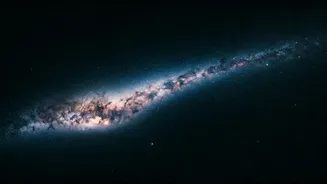
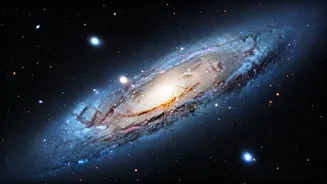
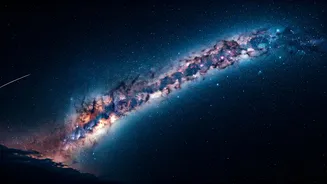
The scale gets even more astonishing when we look beyond the stars in our own galaxy. On a very dark, clear night, far from city lights, you might be able to spot a faint, fuzzy patch in the sky. This is the Andromeda Galaxy, the nearest major galaxy to our own Milky Way. That faint smudge of light is 2.5 million light-years away. The light you are seeing from Andromeda tonight left its source 2.5 million years ago. At that time, our own species, Homo sapiens, did not exist. The Earth was populated by our early hominid ancestors like Australopithecus. The photons hitting your eyes from the Andromeda Galaxy are older than human history itself. You are looking at a cosmic fossil with your naked eye, a relic from a time so deep it’s hard to comprehend.