



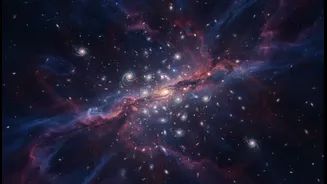


A Cosmic Magnifying Glass
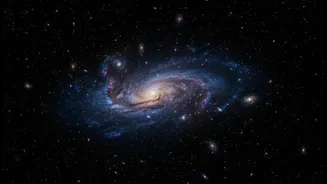
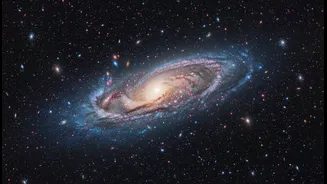
The object at the heart of this discovery isn't a single star but an entire galaxy, seen as it was about 9 billion years ago. Its nickname, the 'Sparkler Galaxy,' comes from the bright, compact objects glittering around it. Ordinarily, a galaxy so distant
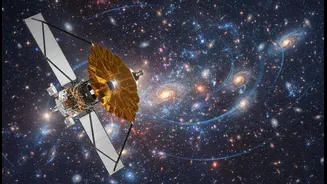
would be too faint to study in detail. However, astronomers got a lucky break thanks to a phenomenon called gravitational lensing. A massive galaxy cluster sitting between Earth and the Sparkler acts like a natural telescope, using its immense gravity to bend and magnify the distant galaxy's light. This cosmic 'zoom lens' provides a magnified view that is crucial for seeing the fine details necessary to understand this primitive system.
Glimpsing the Universe's Toddler Years
Looking deep into space is the same as looking back in time. The light from the Sparkler Galaxy has traveled for billions of years to reach us, offering a snapshot of the universe in its relative youth. While not from the absolute 'cosmic dawn' when the very first galaxies formed, this era is a critical period. It was a time when galaxies were actively growing and assembling, a chaotic and formative stage. By studying galaxies like the Sparkler, scientists can test their theories about how larger, more structured galaxies like our own Milky Way came to be. It’s the cosmic equivalent of studying a toddler to understand adult development.
The Sparkles Hold the Secret
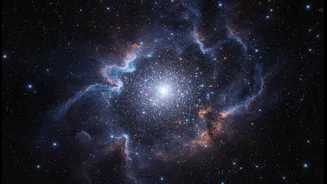
The most exciting part of the discovery lies in the 'sparkles' themselves. Detailed analysis revealed these are not individual stars but are instead extremely dense and ancient star clusters known as globular clusters. These are massive, spherical collections of hundreds of thousands, or even millions, of old stars bound tightly by gravity. Our own Milky Way has about 150 of them orbiting its halo. Finding what appear to be globular clusters in the process of forming in the early universe is a monumental discovery. It provides a direct look at the birth of these ancient objects, which serve as fossils from the era of galaxy formation.
Rewriting the Story of Galaxy Birth
The presence of these nascent globular clusters around the Sparkler Galaxy provides crucial evidence for how galaxies assemble. One of the leading theories is that galaxies grow hierarchically, with smaller structures forming first and then merging to create larger ones. These observations support that model in stunning fashion. The 'sparkles' appear to be some of the first building blocks of the galaxy's halo. They provide a fossil record of the conditions in the early universe, showing that massive star clusters could form under the intense pressures and gas-rich environments of young galaxies. It’s a key piece of the puzzle of how galaxies get their structure.
The Future of Cosmic Archaeology
This Hubble discovery has opened a new window into the past, but it's just the beginning. The findings have been complemented and expanded upon by observations from the James Webb Space Telescope (JWST), which can peer even deeper into the infrared universe. While Hubble helped identify the Sparkler and its unique characteristics, JWST's power allows for even more detailed analysis of the chemical makeup and age of these ancient star clusters. Together, these powerful observatories are acting as a team of cosmic archaeologists, digging through the layers of time to uncover the fundamental story of where galaxies, stars, and ultimately we, came from.