



The Need for Inviolate Space
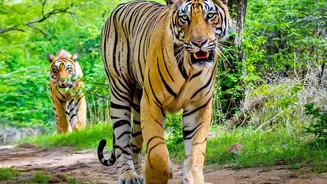
Tigers are territorial predators that require vast, undisturbed areas to roam, hunt, and breed. Scientific studies suggest a single viable population of 80-100 tigers needs a core habitat of at least 800-1200 square kilometres. When human settlements
exist within these critical zones, conflict is almost inevitable. Livestock grazing degrades the forest, and competition for resources puts pressure on the tiger's natural prey base. This fragmentation of habitat not only hinders population growth but also increases the chances of human-wildlife conflict, which can be fatal for both tigers and people. To address this, the concept of 'inviolate' or 'critical tiger habitats' was established under the Wild Life (Protection) Act, 1972. These core areas are legally mandated to be free from human disturbance, making the relocation of villages from these zones a key conservation strategy.
The Relocation Blueprint
The process is officially known as the Voluntary Village Relocation Program (VVRP), managed by the National Tiger Conservation Authority (NTCA). The framework is guided by both the Wild Life (Protection) Act and the Forest Rights Act, 2006, which legally requires that any relocation must be voluntary and carried out with the informed consent of the affected communities. Families who agree to move are typically offered two main options. The first is a cash compensation package, which has been increased over the years and currently stands at ₹15 lakh per family. The second option involves the forest department managing the relocation, providing new land, housing, and basic amenities at a site outside the protected area. State and district-level committees are responsible for overseeing the process to ensure it is transparent and fair, though the effectiveness of this oversight varies.
Success Stories for Tigers
From a conservation perspective, the results have often been remarkable. Once villages are moved and human activity ceases, forests begin to regenerate. Studies show that with the return of lush grasslands and water sources, populations of prey animals like deer and antelope surge. This revitalised prey base is crucial for supporting a growing predator population. Several tiger reserves serve as powerful examples. Sariska, which had lost its entire tiger population to poaching by 2004, has seen a stunning recovery after a successful reintroduction program was coupled with village relocations. Similarly, Panna Tiger Reserve, which faced a similar crisis, now has a thriving tiger population after implementing relocation schemes. In Satpura Tiger Reserve, the relocation of 49 villages has freed up significant tracts of land, leading to an increase in both prey and carnivore populations. These successes demonstrate that creating inviolate spaces is a highly effective tool for tiger recovery.
The Human Cost and Social Impact
The story for the relocated people is far more mixed. While the program's official goal is a 'win-win' scenario, the reality on the ground can be fraught with challenges. Many communities, particularly indigenous groups like the Baiga, have deep cultural and ancestral ties to the land, which are severed upon moving. The process, meant to be voluntary, has faced allegations of coercion and mismanagement, with claims that consent is sometimes obtained through pressure and harassment. Even when the process runs smoothly, relocated families face immense hurdles. They are often moved to an unfamiliar environment where their traditional knowledge and livelihood skills, like gathering forest produce, are no longer relevant. While relocation can bring benefits like better access to healthcare, education, and electricity, it can also lead to joblessness, food insecurity, and social disarticulation. The quality of new land and housing provided has also been a frequent point of contention, with some families left in worse conditions than before.
Balancing Act for the Future
Despite the progress—nearly 300 villages have been relocated from core areas over the decades—a significant task remains, with over 700 villages still residing inside these critical habitats across India. The success of this immense conservation challenge hinges not just on creating space for tigers, but on ensuring justice and improved quality of life for the people who make way for them. Conservationists and social scientists agree that the process needs more than just a financial package; it requires robust, long-term support. This includes ensuring the process is genuinely voluntary, providing high-quality agricultural land and infrastructure, and offering sustained 'handholding' to help communities adapt to new livelihoods and a new way of life. The ultimate success of India's tiger conservation story will be measured not only by the roar of the big cat, but by the well-being of the communities who share its landscape.