






An Alignment Is Not What It Seems
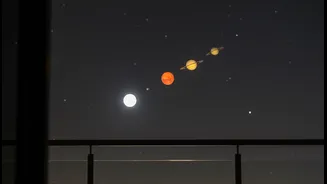
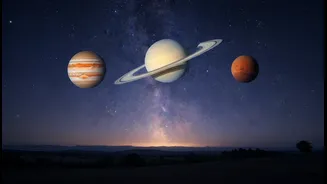
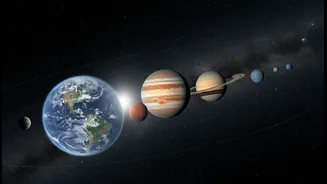
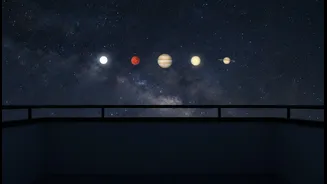
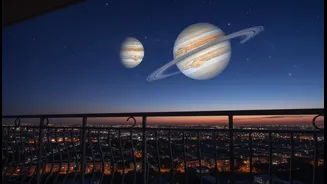
First, let's clarify what a planetary 'alignment' or 'grouping' actually is. When you see planets like Venus, Mars, Jupiter, and Saturn in the same patch of sky, they aren't physically close to one another. They are still separated by hundreds of millions
of kilometres. What you are witnessing is a line-of-sight phenomenon from our perspective here on Earth. Because all the planets orbit the Sun on a relatively flat plane called the ecliptic, they follow a similar path across our sky. A grouping simply occurs when several planets happen to be on the same side of the Sun at the same time, appearing as a 'parade' from our viewpoint. A true, perfect, straight-line alignment is extraordinarily rare.
A Racetrack in the Heavens
One of the most fundamental concepts these groupings illustrate is that planets move at different speeds. Think of the solar system as a vast, multi-lane racetrack with the Sun at the center. Planets in the inner lanes, like Mercury and Venus, have a shorter distance to travel and move much faster. Planets in the outer lanes, like Jupiter and Saturn, move more slowly on their immense circuits. This concept is a core part of Kepler's Laws of Planetary Motion. When a speedier inner planet 'laps' a slower outer one, we see them pass close to each other in the sky — an event called a conjunction. Watching this celestial chase over days and weeks provides a real-world visualization of the solar system’s grand, gravitational rhythm.
Visualizing an Invisible Plane
While we often imagine the solar system as a perfectly flat disc, the reality is slightly different. Each planet’s orbit is tilted at a small angle relative to Earth’s orbit; this is known as orbital inclination. The orbital planes are not perfectly aligned with one another. Planetary groupings make this three-dimensional aspect tangible. When planets appear together, you'll often notice that they don't form a perfectly straight line. One might be slightly higher or lower than the others. This visible offset is a direct consequence of their different orbital tilts. Mercury, for instance, has an orbit tilted by about 7 degrees compared to Earth's, which is why it often appears noticeably above or below the main path of the other planets.
The Clockwork of Kepler's Laws
Johannes Kepler figured out the rules of planetary motion in the 17th century, and planetary groupings are a fantastic way to see his laws in action without needing complex mathematics. His first law states that planets move in ellipses (stretched circles), not perfect circles. His second law explains that a planet moves fastest when it is closest to the Sun in its orbit and slowest when it is farthest away. Observing a faster planet like Mars catch up to and overtake a slower one like Jupiter directly demonstrates these varying speeds and orbital paths. His third law relates a planet's orbital period to its distance from the Sun, explaining why the outer planets take so much longer to complete their journeys. These celestial events turn abstract laws into observable predictions.