



The Cosmic Speed Limit
Everything we see is thanks to light. When you look at a friend across the room, light bounces off them and travels to your eyes. This seems instantaneous because, on Earth, it practically is. But light has a finite speed—a universal speed limit. In the vacuum
of space, light zips along at a blistering 2,99,792 kilometres per second. While that's incredibly fast, it's not infinite. The vast distances between stars mean that even at this breakneck pace, light needs time to travel. This delay is the key to our cosmic time travel. What you see is not the star as it is right now, but the star as it was when that specific photon of light began its long journey towards you.
Measuring Space with Time
Because the distances in space are so mind-bogglingly huge, using kilometres is impractical. Instead, astronomers use a unit called a 'light-year'. This isn't a measure of time, but of distance. One light-year is the distance light travels in a single year—a staggering 9.46 trillion kilometres. Thinking in light-years simplifies things and beautifully ties distance to time. If a star is 10 light-years away, it means the light we see from it tonight left that star 10 years ago. You are seeing a decade into that star's past. This principle is what astronomers call 'lookback time', and it applies to everything in the universe beyond our own planet.
Our Nearest Neighbours in Time
Let's make this concrete. The closest star system to our sun is Alpha Centauri. Its closest star, Proxima Centauri, is about 4.24 light-years away. So, when you gaze at it (you’ll need a telescope in the Southern Hemisphere), you're seeing light that started its journey when you might have been starting a new school year over four years ago. A more familiar sight for us in India is Sirius, the brightest star in our night sky. Also known as the Dog Star, Sirius is about 8.6 light-years away. The twinkle you see tonight is from light that left Sirius in late 2015. It has spent nearly a decade crossing the cosmic void just to reach your eyes.
Gazing at Ancient History
The further we look, the further back in time we see. Take Polaris, the North Star, a celestial beacon for travellers for centuries. Polaris is approximately 433 light-years away. The faint, steady light you see from it tonight began its journey around the year 1591, when the Charminar was being completed in Hyderabad. Now consider a star like Betelgeuse, the prominent reddish star in the Orion constellation. It is about 640 light-years away. The light we see from it left during the Mughal era in India, long before the Industrial Revolution even began. If Betelgeuse were to explode in a supernova right now, we wouldn't know about it for another six centuries. We are always watching a delayed broadcast of the cosmic drama.
Seeing Across Galaxies
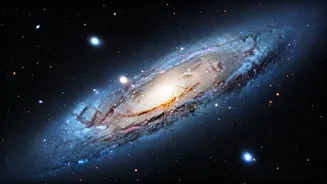
This time-travel effect becomes even more profound with objects outside our own galaxy. The Andromeda Galaxy is the most distant object you can see with the naked eye under dark skies. It appears as a faint, fuzzy smudge, but that smudge is made of light that has travelled for 2.5 million years to reach us. When that light began its journey, modern humans did not exist. Our earliest ancestors were just beginning to walk the Earth. Every time you look at the Andromeda Galaxy, you are seeing a snapshot of a time long before any recorded human history. You are, in the most literal sense, looking at a prehistoric fossil made of light.