


The Roots of Stability: Mastering Basic Tree Pose
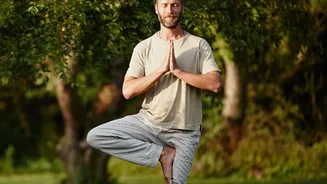
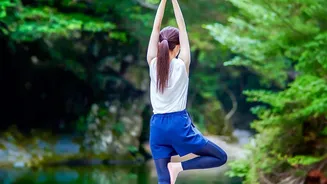
Before exploring the branches, you must establish strong roots. Begin in Mountain Pose (Tadasana), standing tall with your feet together or hip-width apart. Shift your weight onto your left foot, grounding it firmly into the mat. Bend your right knee
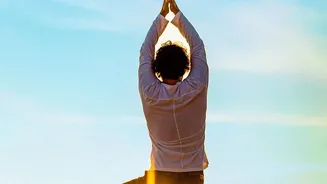
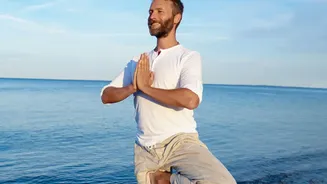
and place the sole of your right foot on your inner left ankle, calf, or thigh. A crucial safety rule is to always avoid placing the foot directly on the knee joint, as this can cause strain or injury. Once your foot is placed, press it firmly into your standing leg, and press the leg back into the foot to create a stable connection. Keep your hips level and facing forward. Fix your gaze (drishti) on a stationary point in front of you to help maintain balance. Bring your hands to a prayer position at your heart, or for a greater challenge, extend them overhead like branches. Hold for 5-10 steady breaths before gently releasing and repeating on the other side.
Finding Your Ground: Beginner Modifications
Balance doesn't happen overnight, and there are many ways to build confidence in Tree Pose. If you feel wobbly, start by practicing near a wall, using it for light support with your fingertips. Another excellent modification is to use your lifted foot like a kickstand, resting your toes on the floor and your heel against your standing ankle. As you feel more stable, you can progress to placing the foot on your calf. The goal is to build strength and awareness without frustration. You can also keep your hands on your hips for added stability instead of lifting them. Remember, any variation that helps you feel grounded and steady is the 'correct' pose for you today.
Growing Your Branches: Intermediate Variations
Once you feel comfortable and stable in the classic Tree Pose for an extended period, you can begin to explore different 'branch' movements. This not only challenges your balance further but also adds new stretches and benefits. From a stable Tree Pose, try a side bend by reaching your arms overhead and gently arching your torso to one side, creating a 'Bending Tree'. This variation stretches the side of your waist while demanding more core engagement. Another option is to introduce a gentle twist; keep your hips square to the front and rotate your upper body, extending your arms out to the sides like branches blowing in the wind. These movements teach you to maintain a stable foundation while your upper body is more dynamic.
Exploring the Canopy: Advanced Expressions
For seasoned practitioners looking for a deeper challenge, Tree Pose can evolve significantly. One common advanced variation is the Half-Lotus Tree Pose (Ardha Padmasana in Vrikshasana). In this version, the lifted foot is placed on the opposite hip crease, creating a much deeper hip-opening stretch. This requires significant flexibility and should only be approached with care. Another way to intensely challenge your balance is to practice with your eyes closed. Closing your eyes removes your 'drishti', forcing you to rely entirely on proprioception—your body's internal sense of its position in space. For the ultimate test of focus and strength, some yogis even take the leg position of Tree Pose into other challenging asanas like Side Plank or Handstand.
More Than Just Balance: The Mental Benefits
While Vrikshasana is known for strengthening legs, ankles, and core muscles, its mental benefits are just as profound. The intense focus required to stand on one foot serves as a form of moving meditation. It demands your full attention, quieting the mental chatter and pulling you into the present moment. Holding the pose teaches patience and resilience; some days you will feel perfectly stable, and other days you will wobble. The practice is not about achieving perfect stillness but about learning how to find your center again and again. This cultivation of steady focus and calm acceptance can translate directly off the mat, helping you navigate life's challenges with more grace and stability.