

The First Line of Defence: The Co-Pilot
The most critical safety system in the cockpit isn't a computer—it's the second pilot. Every commercial flight has at least two pilots: a Captain and a First Officer (or co-pilot). Both are fully qualified and certified to fly the aircraft independently.
They typically share duties, with one designated as the 'pilot flying' and the other as the 'pilot monitoring' for each leg of a journey. If the Captain were to become incapacitated, the First Officer is trained to take complete control, notify air traffic control, and divert to the nearest suitable airport. This two-pilot rule is the foundational layer of safety, ensuring a trained and capable professional is always at the controls. Procedures are drilled to handle this exact scenario, including physically securing the incapacitated pilot so they do not interfere with the controls.
Teamwork in the Skies: Crew Resource Management
Modern aviation safety is built on a philosophy called Crew Resource Management (CRM). Originating in the late 1970s, CRM is a set of training procedures that emphasizes teamwork, communication, and decision-making among all crew members. It’s not just about the pilots; it includes flight attendants, dispatchers, and air traffic controllers. CRM fosters a less rigid cockpit culture where First Officers are encouraged to challenge Captains if they spot an error. In an incapacitation event, CRM training is vital. The remaining pilot works closely with the cabin crew, who are trained to provide assistance, and with controllers on the ground. This framework ensures that the response is a coordinated team effort, not a solo act.
The Plane That Can Help Fly Itself: Autopilot
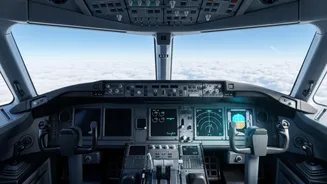
The autopilot system is a powerful tool that significantly reduces workload and enhances safety. In the event of an incapacitation, the remaining pilot can engage the autopilot to manage the aircraft's heading, altitude, and speed. This frees them up to focus on other critical tasks like communicating with air traffic control, running checklists, and planning a diversion. The autopilot can fly a pre-programmed route or be guided by commands from the pilot. While it's not a substitute for a human pilot's decision-making skills, it is an essential resource that provides stability and buys precious time during an emergency. The integration of advanced automation has made flying safer and more manageable, especially in high-stress situations.
A Voice on the Ground: Air Traffic Control
When a pilot declares an emergency due to incapacitation, they are not alone. Air Traffic Control (ATC) immediately becomes a critical part of the response team. The remaining pilot will declare an emergency (often squawking the 7700 transponder code), which gives them priority handling. Controllers clear airspace, provide vectors to the nearest suitable airport, and coordinate with emergency services on the ground to ensure fire and medical teams are ready upon landing. ATC can provide vital information about weather, runway conditions, and approach procedures, essentially acting as an external resource to ease the pilot's cognitive load. This ground support system is a crucial link in the safety chain, connecting the aircraft to a network of assistance.
A Glimpse of the Future: Emergency Autoland
One of the most remarkable advancements in aviation technology is the development of 'autoland' systems. While standard autoland has been used for decades to help pilots land in low visibility, a new generation of 'emergency autoland' is now appearing on some smaller, newer aircraft. Systems like Garmin's Emergency Autoland can be activated with a single button press. The system can then autonomously choose the best nearby airport, calculate a flight path, communicate with air traffic control, and fly a complete approach and landing without any human input. It controls flaps, landing gear, and braking. While not yet standard on large commercial airliners, which already rely on the two-pilot system, this technology showcases the future of aviation safety and provides an incredible safety net, particularly for single-pilot private aircraft.