


Our Sentinels in the Sky
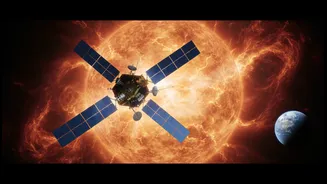
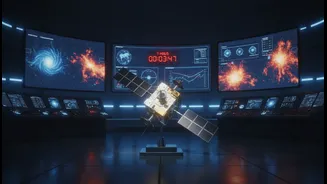
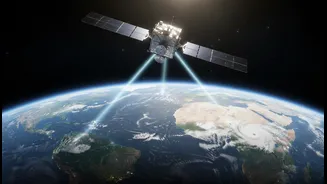
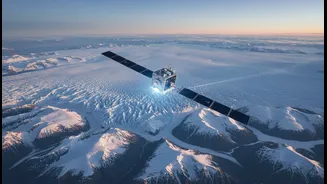
The first line of defence against solar storms is a network of space-based observatories that keep a constant watch on the Sun. Think of them as our dedicated solar sentinels. Missions like NASA's Solar Dynamics Observatory (SDO) and the joint NASA/ESA
Solar and Heliospheric Observatory (SOHO) provide continuous, high-definition views of the Sun's atmosphere. They are strategically positioned to never lose sight of our star, allowing scientists to spot the tell-tale signs of an impending eruption. These observatories capture images across multiple wavelengths of light, revealing the complex magnetic activity on the solar surface that often precedes a flare. By watching sunspot groups—cooler, magnetically intense areas where flares originate—forecasters can assess the likelihood of an eruption.
India’s Eye on the Sun: Aditya-L1
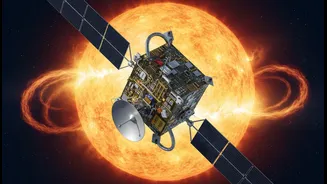
A crucial new player in this global effort is India's own Aditya-L1 mission. Launched by ISRO, it is strategically placed at Lagrange Point 1 (L1), about 1.5 million kilometres from Earth, giving it an uninterrupted view of the Sun. This vantage point is critical, as it allows Aditya-L1 to observe solar flares and coronal mass ejections (CMEs) without any blockage from the Earth or Moon. The spacecraft is equipped with seven advanced payloads designed to study the Sun’s various layers, from the photosphere to the corona. Instruments like the Solar Ultraviolet Imaging Telescope (SUIT) and X-ray spectrometers (SoLEXS and HEL1OS) allow Indian scientists to detect the earliest signs of a flare and analyse the burst of radiation, contributing vital data to global space weather prediction efforts.
The Specialist Toolkit for Solar Storms
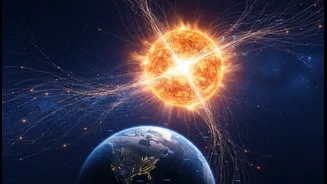
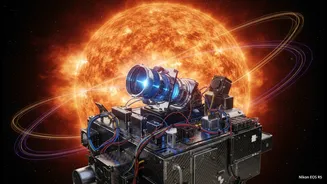
Monitoring solar flares requires a specialised set of instruments. It’s not just about taking a picture. Telescopes like the Solar Ultraviolet Imager (SUVI) aboard GOES satellites capture images in the extreme ultraviolet range, allowing scientists to see the structure of a flare as it erupts. At the same time, X-ray sensors measure the intensity of the flare, classifying it on a scale from A (weakest) to X (strongest). Another key instrument is the coronagraph, which blocks out the Sun's bright face to see the much fainter corona. This is essential for tracking Coronal Mass Ejections (CMEs)—massive clouds of plasma and magnetic fields often launched with flares—as they travel through space. These CMEs are often the most dangerous part of a solar storm, taking one to three days to reach Earth.
From Data to Warning
Collecting data is only half the battle. This stream of information from observatories like Aditya-L1, SDO, and GOES is funnelled to space weather prediction centres, such as NOAA's Space Weather Prediction Center (SWPC) in the United States. Here, forecasters work 24/7, analysing the data to determine the size, speed, and direction of a solar eruption. They use sophisticated computer models, like the WSA-Enlil model, to simulate how a CME will travel through the solar system and whether it will impact Earth. Based on this analysis, they issue watches, warnings, and alerts to government agencies, satellite operators, airlines, and power grid companies, giving them crucial lead time to prepare for the storm's arrival.
Shields Up: Protecting Our Orbital Assets
Once a warning is issued, satellite operators have several strategies to protect their multi-billion dollar assets. The primary threats are radiation damage to electronics, increased atmospheric drag, and spacecraft charging. For satellites in low-Earth orbit, a major storm can heat and expand the upper atmosphere, increasing drag and causing orbits to decay. To counter this, operators can use on-board thrusters to maintain altitude. For high-energy particle radiation, which can fry sensitive circuits, operators might put the satellite into a 'safe mode'. This involves shutting down non-essential systems and reorienting the spacecraft to present its most shielded side to the incoming storm. Many critical satellites are also built with radiation-hardened components and physical shielding to withstand the harsh space environment.