




A Landmark Discovery in Distant Skies
In a significant leap for planetary science, astronomers using the James Webb Space Telescope (JWST) have found compelling evidence of water vapour on rocky exoplanets. While water has been detected on giant gas planets before, finding its signature around
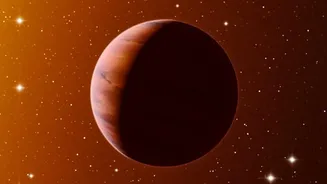
a rocky world is a long-awaited milestone. These planets, known as 'super-Earths', are more massive than our own but are still primarily rock-based, unlike gas giants like Jupiter. The recent findings, including potential detections around planets like GJ 486 b and 55 Cancri e, are not suggestive of habitable worlds—these specific planets are often scorching hot 'lava worlds' due to their proximity to their stars. However, the discovery is monumental because it proves that rocky planets can retain significant atmospheres and that JWST has the power to detect key molecules within them.
How Webb Reads an Alien Atmosphere
Detecting molecules from light-years away sounds like science fiction, but it's the reality of modern astronomy thanks to a technique called transit spectroscopy. When an exoplanet passes in front of its host star from our perspective, a tiny fraction of the starlight filters through the planet's atmosphere. The powerful instruments aboard the JWST, such as its Near-Infrared Spectrograph (NIRSpec), can analyze this filtered light. Different molecules in an atmosphere absorb specific wavelengths, or colours, of light. Water, carbon dioxide, and methane each leave a unique chemical fingerprint on the starlight's spectrum. By studying which colours are missing, scientists can deduce the chemical composition of the alien atmosphere, even from dozens of light-years away.
A Tale of Two Possibilities
The scientific community remains cautiously optimistic. One of the main challenges is confirming that the detected water vapour belongs to the planet and not its star. Some cooler red dwarf stars can have water vapour in cool regions called starspots. A signal from these spots could, in some cases, mimic the signature of a planetary atmosphere. For planets like the ultra-hot 55 Cancri e, scientists theorize the atmosphere is constantly being replenished by gases venting from a molten rock ocean on its surface. This process, called outgassing, could explain how such a hostile world maintains an atmosphere against the stripping force of its nearby star. The current findings are a crucial first step, prompting further observations to rule out stellar contamination and confirm the atmospheric details.
Why Water Matters in the Search for Life
Water is considered the fundamental ingredient for life as we know it, so its discovery in any form is a cause for excitement. Detecting water vapour on a rocky planet, even an inhospitable one, is a profound proof of concept. It demonstrates that the building blocks for habitability can and do exist on planets other than Earth. While the super-Earths currently under study are too extreme to support life, these observations are paving the way for future investigations into more temperate, Earth-like worlds. Each detection refines our understanding of how planets form and evolve, bringing us one step closer to answering the ultimate question: are we alone in the universe?
The Dawn of a New Era in Exploration
These discoveries mark the beginning of a new chapter in exoplanet research. Before the JWST, detecting any atmosphere around a rocky planet was largely impossible. Now, astronomers have a tool capable of peering into the chemical makeup of these distant worlds. The goal is no longer just finding planets, but characterizing them. Future observations will focus on planets in the 'habitable zone'—the orbital region where temperatures could allow for liquid water on a planet's surface. The telescope will search for a full suite of molecules, including not just water but also methane and carbon dioxide, to build a complete picture of these worlds and assess their potential for hosting life.