




Why a Flexible Spine Matters
Your spine is the central support for your entire body, affecting how you move, breathe, and even feel. Maintaining its flexibility is crucial for more than just impressive yoga poses. A mobile spine helps distribute physical stress evenly, preventing
certain areas from becoming overloaded and reducing injury risk. It supports good posture, allows for efficient movement in daily tasks like bending and reaching, and can even promote better breathing by creating space for your diaphragm to function properly. A consistent, gentle practice that encourages spinal mobility can help alleviate stiffness, reduce pain, and improve your overall quality of life.
Tips for a Safe and Comfortable Practice
Before you begin, create a comfortable space. Find a quiet, clutter-free area where you have enough room to move. A non-slip yoga mat is ideal, but a rug can also work. Wear comfortable clothing that doesn’t restrict your movement. Most importantly, listen to your body. A gentle stretch is good, but you should never feel sharp pain. The goal is to relax into the poses, not force them. If a movement feels uncomfortable, ease off. Using props like a folded blanket under your knees or a pillow for support can make poses more accessible and enjoyable.
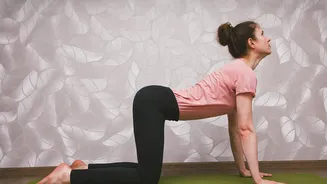
Movement 1: Cat-Cow Stretch (Marjaryasana-Bitilasana)
This is the perfect warm-up to awaken your spine. Start on your hands and knees in a 'tabletop' position, with your wrists directly under your shoulders and your knees under your hips. Inhale as you begin the 'Cow' phase: drop your belly towards the mat, lift your chest and chin, and gaze forward. As you exhale, move into 'Cat': gently round your spine upward, tucking your chin to your chest and drawing your navel in. Continue flowing between these two poses for at least one minute, letting your breath guide the movement. This sequence gently mobilizes the entire spine, relieving tension from your neck to your lower back.
Movement 2: Child's Pose (Balasana)
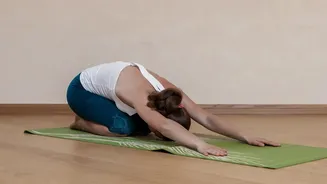
Child's Pose is a resting posture that provides a gentle, passive stretch for your entire back. From your hands and knees, bring your big toes to touch and spread your knees hip-width apart or wider. As you exhale, sit your hips back towards your heels and fold your torso forward, resting your forehead on the mat. Your arms can be extended in front of you or rest alongside your body with palms facing up. Breathe deeply into your back, feeling it lengthen and release with each breath. Hold this restorative pose for 30 seconds to a minute, or for as long as it feels good.
Movement 3: Supine Spinal Twist (Supta Matsyendrasana)
This reclining twist gently rotates the spine, helping to release tension in the lower back and improve mobility. Lie on your back with your knees bent and feet flat on the floor. Extend your arms out to the sides in a 'T' shape. Exhale and gently drop both knees over to one side. For a comfortable stretch, try to keep both shoulders grounded on the mat, even if your knees don't touch the floor. You can turn your head to gaze in the opposite direction of your knees if it feels good for your neck. Hold for 30 seconds, breathing into the stretch, before returning to the center and repeating on the other side.
Movement 4: Bridge Pose (Setu Bandhasana)
Bridge Pose is a gentle backbend that helps strengthen your back muscles while stretching the chest, neck, and spine. Lie on your back with your knees bent, feet flat on the floor hip-width apart, and heels close enough to touch with your fingertips. Press firmly into your feet and arms to lift your hips off the floor. This pose creates a gentle arch in the spine, counteracting the effects of slouching. To make it more restorative, you can slide a block or firm pillow under your lower back for support. Hold for up to one minute, breathing steadily, then slowly roll your spine back down to the floor.