



A Tale of Two Galaxies
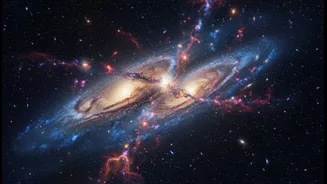
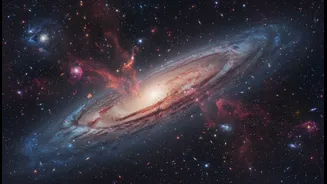
At its heart, the story of Centaurus A is a story of a colossal collision. Astronomers believe that this massive elliptical galaxy crashed into a smaller spiral galaxy hundreds of millions of years ago. This cosmic merger is responsible for the galaxy's
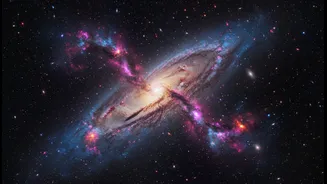
peculiar and iconic appearance. Instead of a smooth, uniform glow typical of most elliptical galaxies, Centaurus A is sliced in half by a dark, warped band. This dramatic feature is not a shadow but the mangled remains of the smaller spiral galaxy, its dust and gas now violently incorporated into the larger galaxy's structure. This event has made Centaurus A a perfect, relatively close laboratory for studying the dramatic effects of galactic mergers, which are fundamental processes in how the universe evolves.
The Engine at the Core
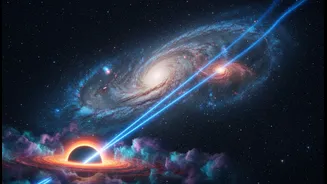
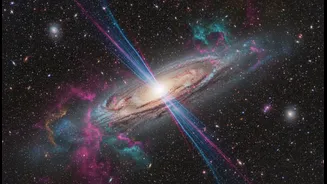
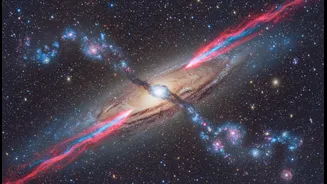
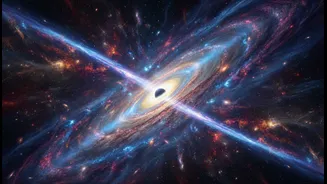
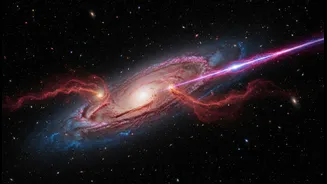
At the center of all this chaos is a true monster: a supermassive black hole with the mass of about 55 million Suns. This isn't a quiet, dormant black hole. It is an Active Galactic Nucleus (AGN), furiously feeding on the gas and dust that falls into its gravitational grip. As material swirls into the black hole, it releases immense amounts of energy, powering two enormous jets of particles that shoot out from the galaxy's core at nearly half the speed of light. While the galaxy itself is tens of thousands of light-years across, these jets extend for over a million light-years into intergalactic space, visible only to radio and X-ray telescopes. This powerful engine profoundly shapes the galaxy, influencing where and how new stars can form.
A Cosmic Belt of Dust
The most visually striking feature of Centaurus A is its thick, dark dust lane. For a long time, this dust obscured our view of what was happening at the galaxy's core. But thanks to infrared telescopes like the James Webb Space Telescope, we can now peer through the dust. What we see is a complex, parallelogram-shaped structure of dust and gas, glowing from the energy of the active black hole and newly forming stars. This dust is not just debris; it's the raw material for future generations of stars and planets. Within these dark clouds, dense pockets of gas are collapsing under their own gravity, providing the fuel for a new wave of stellar birth triggered by the ancient collision.
Where New Stars Are Born
A galactic collision is a violent but also creative event. The shockwaves from the merger of Centaurus A with its smaller companion have compressed vast clouds of hydrogen gas, triggering a firestorm of star formation. Bright clusters of hot, young, blue stars can be seen tracing the edges of the dark dust lane, where the gas is most turbulent. These stellar nurseries are a direct consequence of the collision, showing how galactic encounters can spark new life. The central black hole also plays a dual role: its activity can compress gas to create stars, but its powerful jets and radiation can also blow that same gas away, effectively shutting down star formation in certain regions. Centaurus A provides a rare, close-up look at this delicate cosmic balancing act.