





For decades, the hunt for alien life has meant searching for a mirror image: an Earth 2.0 orbiting a Sun 2.0. But what if we've been limiting our search? A fascinating concept is gaining traction: maybe we should be looking for worlds better than our own.
Rethinking the 'Goldilocks Zone'
For years, our search for habitable planets has been guided by the 'Goldilocks Zone' principle. This refers to the region around a star where conditions are not too hot and not too cold for liquid water to exist on a planet's surface—a key ingredient for life as we know it. This has naturally led us to focus on stars like our own Sun, a G-type yellow dwarf, and planets of a similar size and mass to Earth. The discovery of thousands of exoplanets has confirmed that planets are common, but this 'Earth-centric' approach might be a form of bias. Scientists are now asking a profound question: Is Earth the best planet for life, or just the best we know? This shift in perspective is opening up a new frontier in the hunt for life beyond our solar system.
What Makes a World 'Superhabitable'?
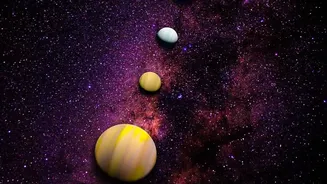
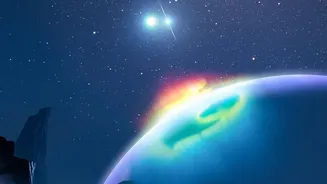
The term 'superhabitable' was coined to describe planets that might offer conditions even more favourable to the emergence and evolution of life than Earth. Proposed criteria suggest that a planet slightly larger and more massive than Earth could be a better home for life. Greater mass means stronger gravity, which can hold onto a thicker atmosphere, offering better protection from harmful cosmic radiation. A slightly warmer average temperature, perhaps by about 5°C, could foster greater biodiversity. An ideal world might also be older than Earth, giving complex life more time to evolve. Instead of looking for an exact twin, scientists are creating a checklist for a planet that is 'Earth, but better', potentially with vast, shallow oceans teeming with a greater variety of life.
The Problem with Sun-Like Stars
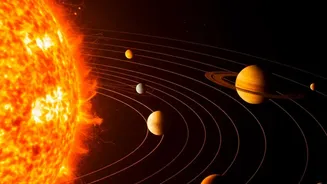
While our Sun has nurtured life on Earth for nearly four billion years, it has a finite lifespan of about 10 billion years. It's already about halfway through its life. In cosmic terms, complex life appeared on Earth relatively recently. This suggests that for planets orbiting stars with even shorter lifespans, the window of opportunity for complex organisms to evolve might close before it ever truly opens. Furthermore, as the Sun ages, it gets brighter and hotter. In another billion years or so, Earth will likely be pushed out of the habitable zone, becoming too hot to sustain life as we know it. This makes G-type stars like our Sun potentially less than ideal for fostering life over the immense timescales needed for true complexity and diversity to flourish.
The Promise of 'Goldilocks Stars'
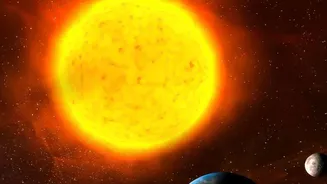
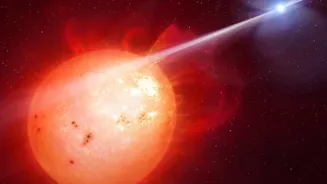
Enter the K-dwarf star, also known as an orange dwarf. These stars are emerging as the true 'Goldilocks stars' for astronomers. They are smaller and cooler than our Sun but warmer and less volatile than the most common stars in the galaxy, the volatile M-type red dwarfs. Crucially, K-dwarfs are incredibly long-lived and stable, with lifespans ranging from 15 to 45 billion years—several times that of the Sun. This incredible longevity provides a vast, stable window of time for life to not only emerge, but to evolve into complex and diverse forms. They are also more common than Sun-like stars, with an estimated 1,000 K-dwarfs located within just 100 light-years of us, significantly increasing the statistical chances of finding a habitable world.
A New Frontier in the Search for Life
By combining the concept of superhabitable planets with the stability of K-dwarf stars, astronomers have a powerful new strategy. The search is no longer just for another Earth, but for an older, larger, and warmer world orbiting a star that can provide a stable energy source for tens of billions of years. In 2020, a study identified 24 potential superhabitable candidates out of the thousands of known exoplanets, all orbiting K-dwarf stars. While none are confirmed, these worlds represent prime targets for next-generation instruments like the James Webb Space Telescope, which can analyse their atmospheres for potential signs of life, or biosignatures. This new approach marks a strategic shift from simply discovering planets to prioritizing the ones most likely to yield an answer to the age-old question: are we alone?