

Why Venus? Earth's Hostile Twin
Imagine a planet almost identical to Earth in size and mass, but with a crushing atmosphere 90 times thicker than our own and surface temperatures hot enough to melt lead. That’s Venus. Scientists believe it may have once been a temperate world with liquid
water oceans, similar to ancient Earth. However, a runaway greenhouse effect transformed it into the inferno we see today. Understanding what went so wrong on Venus is crucial, as it provides a natural laboratory for studying climate change and planetary evolution. It offers cautionary lessons about how drastically a planet's environment can change, giving us insights into the long-term future of our own world.
Shukrayaan: India's Next Interplanetary Leap
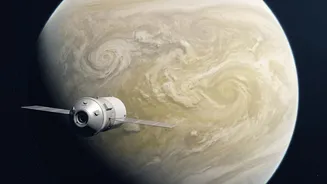
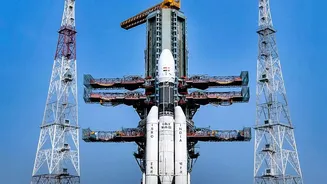
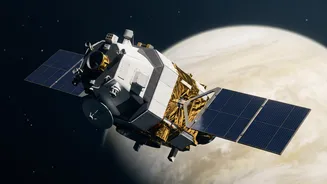
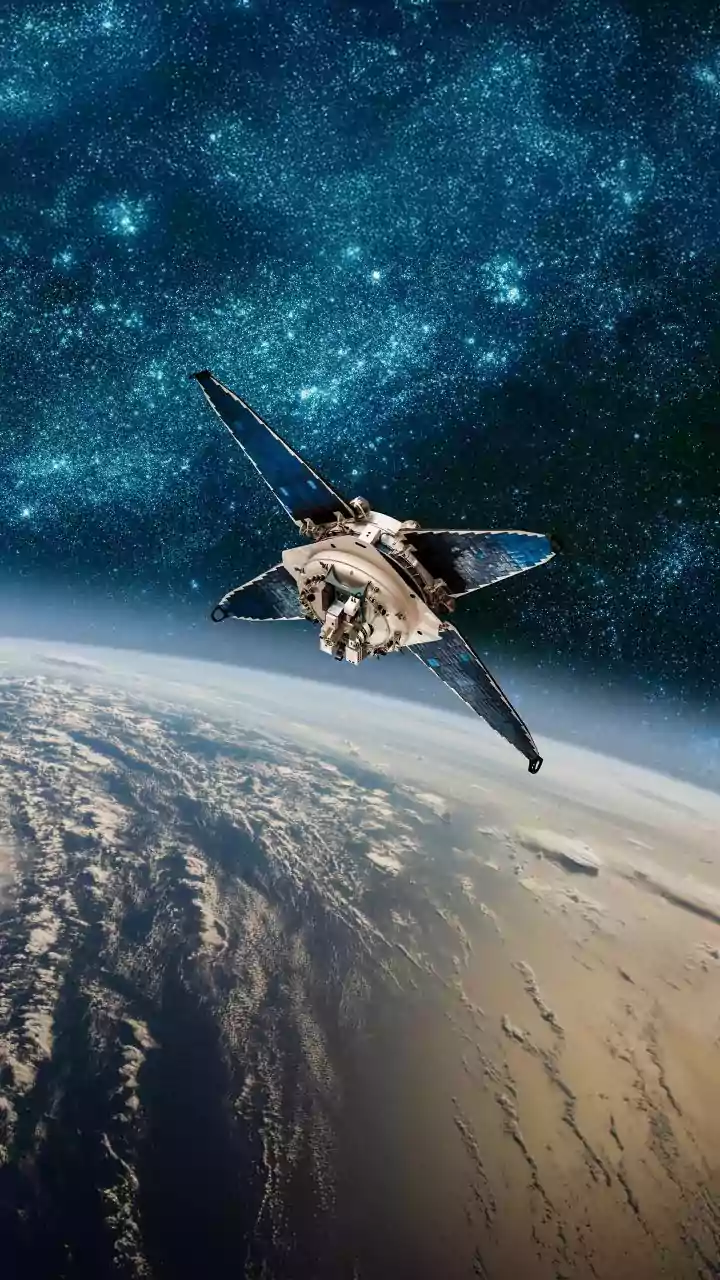
Following the monumental successes of Chandrayaan and the Mars Orbiter Mission (Mangalyaan), ISRO is setting its sights on the second planet from the sun. The Shukrayaan-1 mission, formally approved by the Indian government, is scheduled for a launch in March 2028. It represents India's growing confidence and capability in complex, long-duration space exploration. The primary goal is to conduct a comprehensive four-year study of Venus from orbit, investigating everything from its mysterious surface geology to the complex dynamics of its upper atmosphere and its interaction with the relentless solar wind.
The Star Instrument: Peering Through The Veil
The single greatest challenge to studying Venus is its opaque atmosphere, a permanent blanket of sulphuric acid clouds that makes visual observation of the surface impossible. To overcome this, Shukrayaan's flagship instrument is a high-resolution Synthetic Aperture Radar (SAR). Unlike a regular camera, a SAR sends down radio waves that can penetrate the dense cloud cover. By recording the echoes that bounce back, it can construct a detailed, high-resolution map of the surface terrain, day or night, in any weather. This advanced radar is expected to have up to four times the resolution of NASA's Magellan orbiter from the 1990s, allowing scientists to spot geological features with unprecedented clarity.
Seeing What Lies Beneath
Shukrayaan-1 will go a step further than just mapping the surface; it will be one of the first missions to systematically probe the shallow subsurface. It will carry a ground-penetrating radar, an instrument designed to send lower-frequency radar waves deeper into the planet's crust. This will allow scientists to study the stratigraphy, or the layers of rock and ash, to understand Venus's geological history. A key objective is to search for evidence of active volcanoes, lava flows, and other geological processes. By peering beneath the topsoil, ISRO hopes to uncover clues about whether Venus is still a geologically active world.
A Suite of Scientific Detectives
To get a complete picture, Shukrayaan will carry around 100 kg of scientific instruments, a mix of Indian and international payloads. This includes VIRAL (Venus Infrared Atmospheric Gases Linker), a joint Franco-Russian instrument designed to study the composition of the atmosphere in detail. Another payload, a collaboration with Sweden, is VISWAS (Venus Ionospheric and Solar Wind particle Analyser). This will investigate how charged particles from the sun interact with Venus's upper atmosphere, a key process in understanding how the planet may have lost its water over billions of years. Other sensors will look for lightning, analyse airglow, and take thermal images to hunt for volcanic hotspots.
A Mission of National and Global Importance
The Shukrayaan-1 mission is more than just a scientific endeavour; it's a strategic one. It solidifies India's position as a major player in planetary exploration, building on its reputation for executing cost-effective deep-space missions. The mission will also be a major technology demonstrator for ISRO, particularly in its use of aerobraking. This technique will use the friction of Venus's upper atmosphere to gradually lower the spacecraft from its initial highly elliptical orbit to a more circular one ideal for scientific observation, saving a significant amount of fuel. With international partners from Russia, France, Sweden, and Germany, the mission underscores a collaborative approach to unlocking the secrets of our solar system.