

What Did We Actually Find?
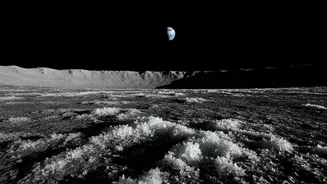
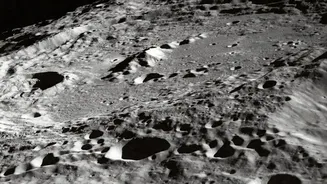
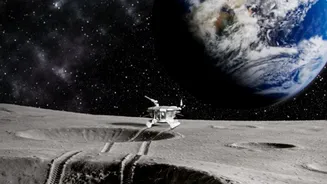
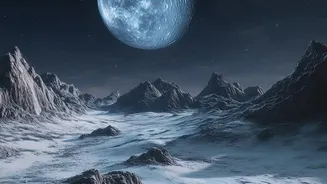
Forget images of frozen lakes. The water on the Moon exists as ice crystals mixed with lunar soil, or regolith, in permanently shadowed craters. For billions of years, these craters at the lunar south pole have been shielded from direct sunlight, creating
incredibly cold traps where temperatures plummet low enough to preserve this ice. Missions like India's Chandrayaan-1 and NASA's Lunar Reconnaissance Orbiter provided the crucial initial evidence, and recent data from instruments like Chandrayaan-2's advanced radar have strengthened these findings, suggesting stable, buried ice deposits. While not a vast, pure sheet, these deposits represent a significant resource, with studies suggesting concentrations may range from a few percent to potentially 20-30% by weight in some areas.
Unlocking Secrets with Light
Detecting this ice from orbit requires some clever science. Spectrometers, like NASA's Moon Mineralogy Mapper (M3) aboard Chandrayaan-1, are key instruments in this search. They work by analyzing light that has bounced off the lunar surface. Different materials absorb and reflect light in unique ways, creating a specific 'signature'. Water ice has a distinct signature in the infrared part of the spectrum. By capturing this reflected light, spectrometers can map the composition of the surface below and differentiate between water ice and its chemical cousin, hydroxyl. This allows scientists to create detailed maps showing the most promising locations for water ice without ever leaving orbit.
The Ultimate Cosmic Gas Station
The primary reason this discovery is so monumental is a concept called In-Situ Resource Utilization, or ISRU. Put simply, it means living off the land. Launching anything from Earth is incredibly expensive, and much of a rocket's mass is its own fuel. Water (H2O) can be split into its component parts: hydrogen and oxygen. These two elements are the primary components of the most powerful rocket propellants. By mining lunar ice and processing it into fuel on the Moon, we can turn our celestial neighbour into a refuelling station. This would dramatically slash the cost of missions to Mars and beyond, as spacecraft could launch from Earth with less fuel, top up at the Moon, and then continue their journey.
More Than Just Rocket Fuel
While propellant is a game-changer, the benefits of lunar water don't stop there. The most obvious use is for life support in a future lunar habitat. Astronauts need water to drink and breathable oxygen. Having a local supply is essential for long-term stays. Beyond that, water is an excellent shield against cosmic radiation, a major hazard for astronauts outside Earth's protective magnetic field. Water could also be used for agriculture, enabling crews to grow their own food. The availability of these basic resources is what makes the dream of a sustainable human presence on the Moon a tangible possibility rather than science fiction.
From Mapping to Mining
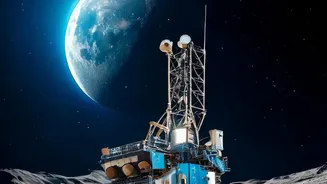
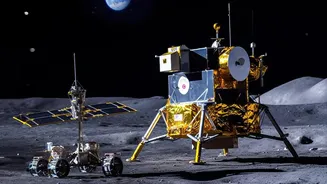
Knowing the water is there is one thing; getting it is another. The challenges are immense. The ice is located in some of the coldest, darkest places in the solar system. Mining operations will require robots and machinery capable of operating in extreme temperatures and the abrasive lunar dust. Engineers must develop methods to excavate the frozen regolith, heat it to release the water vapor, and then capture and purify it. This is a complex and energy-intensive process that must be done with extreme reliability in a hostile environment. Future missions, like the joint ISRO-JAXA LUPEX rover, are being designed specifically to tackle these exploration and extraction challenges head-on.