


A Sea of Unity
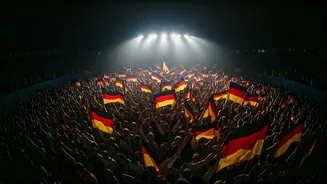
Before a major tournament match, whether in Berlin, Munich, or a host city thousands of kilometres away, it begins. Fans of the German national team, known as Die Mannschaft, gather by the thousands. Dressed in team jerseys, with faces painted and flags
waving, they form a massive, moving procession. This is the 'Fanmarsch' or fan march, a powerful and organised spectacle of collective support. Unlike the spontaneous gatherings of other fanbases, the German version is often a pre-planned river of humanity, flowing purposefully towards the stadium or a public viewing area. It’s a peaceful, yet overwhelming, demonstration of passion that has become as much a part of Germany's World Cup identity as the team itself.
The 2006 Turning Point
This phenomenon didn't exist in its current form until 2006. When Germany hosted the FIFA World Cup that year, the nation was apprehensive. For decades after World War II, public displays of national pride—especially flag-waving—were viewed with deep suspicion and discomfort, linked to a dark past. The tournament's official slogan, 'Die Welt zu Gast bei Freunden' (A time to make friends), was a deliberate attempt to project a new, welcoming German identity. As the team unexpectedly advanced, a wave of joyous, unburdened patriotism swept the country. For the first time, millions felt comfortable waving the German flag. The 'Fanmeile' (Fan Mile) in Berlin, a massive public viewing event, became the epicentre of this new spirit, and the collective marches to these venues were born out of that shared euphoria.
More Than Just a Walk
The fan march is more than just a parade; it’s a symbolic act. In a country where historical memory heavily polices public demonstrations, these football-driven processions reclaim the streets in a positive, inclusive way. They are overwhelmingly peaceful, family-friendly events that stand in stark contrast to the hooliganism that has plagued other European football cultures. For many Germans, particularly younger generations, these marches provided the first-ever template for a healthy, celebratory form of national identity that was divorced from political extremism. It was patriotism expressed through sport—a shared love for a team rather than a political ideology. Sociologists have noted it as a crucial moment of social catharsis, allowing for a public expression of identity that had long been suppressed.
A Global Export
What started at home in 2006 quickly became a German export. At the 2010 World Cup in South Africa, 2014 in Brazil, and 2018 in Russia, the German fan march became a recurring spectacle in host cities. News crews from around the world would gather to film the impressive sight of thousands of German supporters taking over streets in Cape Town, Rio de Janeiro, or Moscow. It became a signal of their arrival, a statement of intent before a ball was even kicked. The marches established Germany's supporters as one of the most visible and organised fan groups in international football. The sight of this moving bloc of fans became an expected part of the World Cup's visual tapestry, influencing other fan groups to organise similar, large-scale processions.
How It Compares
While many nations have passionate fans, the German fan march is distinct. Argentinian 'hinchas' are famous for their relentless, almost religious chanting and bouncing, often in a more chaotic, concentrated mass. The Dutch 'Oranjegekte' (Orange Craze) turns entire city blocks into a vibrant carnival, but it's more of a stationary party. The uniqueness of the German march lies in its combination of scale, organisation, and movement. It’s not just a gathering; it’s a journey. This organised nature reflects a cultural stereotype, perhaps, but it also ensures the events remain safe and impactful, creating unforgettable imagery that dominates social media and news reports on match day.