


A Legacy of Reaching for the Stars
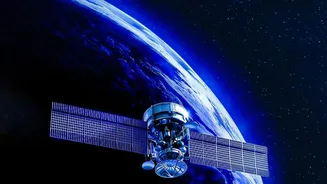
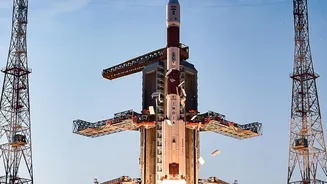
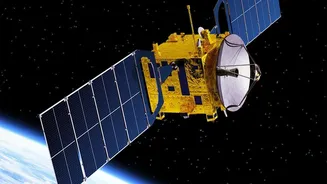
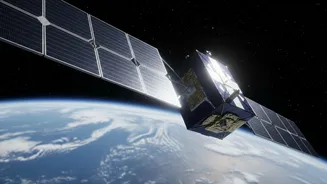
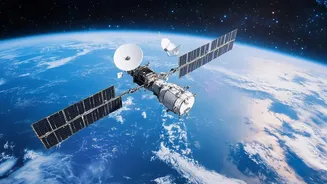
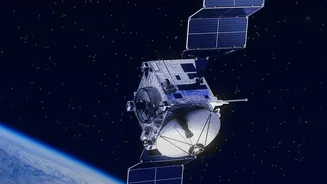
For decades, the Indian Space Research Organisation (ISRO) has built a formidable space infrastructure. Its constellation of satellites is the backbone of modern India, providing essential services in communication, weather forecasting, disaster management,
and navigation through the indigenous NavIC system. These satellites are our eyes in the sky, generating immense volumes of data that help farmers plan their crops, cities manage their expansion, and defence forces monitor our borders. But as the world enters a new technological era, the next great leap for India’s space program lies in making these satellites not just observers, but intelligent and ultra-secure hubs of information.
The AI Co-Pilot: Creating Smarter Satellites
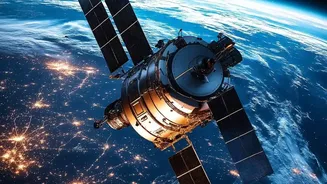
The primary challenge with Earth Observation (EO) satellites is the sheer volume of data they collect. AI and Machine Learning (ML) offer a powerful solution to this data deluge. Instead of beaming torrents of raw data back to Earth for processing, AI will enable satellites to perform analysis on-board. This concept, known as edge computing, allows satellites to identify and send back only the most relevant information. For example, an AI-powered satellite could autonomously detect the early signs of a wildfire or a flood and send an immediate alert, drastically cutting down response times. AI algorithms are already being developed to improve mission planning, automate the classification of land use, and even predict the operational lifetime of satellites themselves. This shift towards intelligent, autonomous systems will make our satellite fleet more efficient, responsive, and capable of delivering real-time insights for governance and disaster management.
The Quantum Leap: Unbreakable Communication
While AI promises to make satellites smarter, quantum technology promises to make them completely secure. Conventional encryption relies on complex mathematical problems that, in theory, could be broken by powerful future computers. Quantum communication, however, is based on the laws of physics. It uses a technology called Quantum Key Distribution (QKD), which makes data transfer inherently 'hack-proof'. Any attempt to intercept the communication would disturb the quantum state, immediately alerting the sender and receiver. ISRO has already made significant strides in this area, successfully demonstrating free-space QKD over a distance of 300 metres. The ultimate goal is Satellite-Based Quantum Communication (SBQC), which would create ultra-secure channels for military communications, strategic operations, and sensitive financial transactions, making them immune to cyber threats. This technology is considered 'future-proof' and essential for national security.
Precision Beyond Measure
Beyond secure communications, quantum technology also promises breakthroughs in sensing and timing. Quantum sensors could dramatically improve the accuracy of navigation systems like NavIC, and enhance the capabilities of Earth observation satellites. For ISRO, this translates into more complex mission planning, better materials modelling for spacecraft, and improved orbital dynamics. The National Quantum Mission, launched in 2023 with a budget of over ₹6,000 crore, is designed to accelerate development in these areas. The mission aims to develop satellite-based secure quantum communications over 2,000 km within India, positioning the country among a handful of nations with dedicated quantum missions.
The Road Ahead: Challenges and Collaboration
Integrating these advanced technologies is a monumental task. It requires not only significant financial investment but also a deep pool of specialised talent. Recognising this, India is fostering a collaborative ecosystem. ISRO is working closely with academic institutions like the Raman Research Institute, IITs, and private sector startups to drive innovation. These partnerships are crucial for translating theoretical research into practical applications, from developing the hardware for quantum processors to writing the AI algorithms that will power the next generation of satellites. While the full impact of these technologies may be years away, the groundwork being laid today is positioning India to become a leader in the next space race—one defined not just by reaching new destinations, but by harnessing the power of data and quantum physics.