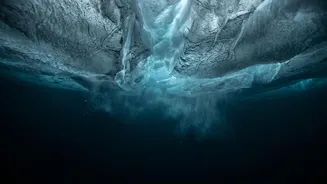





Sensing the Unseen Ocean
Detecting an ocean hidden under kilometres of solid ice sounds like science fiction, but it's a challenge space probes have successfully tackled. Since we can't drill through these thick crusts, scientists rely on a range of clever, indirect methods to
'see' what lies beneath. These techniques turn a whole moon into a natural laboratory, using its own motion, gravity, and magnetic fields to reveal its inner secrets. For moons like Saturn's Enceladus and Jupiter's Europa, this detective work has provided compelling evidence for some of the most promising environments for potential life beyond Earth.
The Wobble and the Pull
One of the most powerful clues comes from gravity and motion. As a moon orbits its massive planet, the planet's gravity pulls on it. If the moon were solid all the way through, it would barely deform. But if it has a global liquid ocean separating the outer ice shell from the rocky core, the shell can move independently. This allows for a much larger 'wobble', or libration, as the moon orbits. By precisely measuring this wobble, scientists can confirm the ice shell is essentially floating. NASA's Cassini spacecraft did just this at Enceladus, with its measurements suggesting the entire crust is detached from the core, confirming the ocean is global. Furthermore, tiny variations in a spacecraft's trajectory as it flies by a moon reveal details about the moon's gravity field. These measurements showed a mass deficit at Enceladus's south pole that was best explained by a deep layer of liquid water, which is denser than the overlying ice.
Cracking the Magnetic Code
Another key technique involves magnetism. A moon like Europa or Enceladus orbits within the giant magnetic field of its parent planet, Jupiter or Saturn. As the moon moves through this field, the field constantly changes from the moon's perspective. If the moon contains a layer of electrically conductive material—like a salty ocean—this changing magnetic field will generate, or 'induce', a secondary magnetic field within the ocean. A sensitive magnetometer on a visiting spacecraft can detect this faint, induced field. This signature is a tell-tale sign of a large, conductive body of liquid. The strength of this induced field can even help scientists estimate the ocean's depth and saltiness, providing crucial details without ever touching the water itself.
Tasting the Ocean Spray
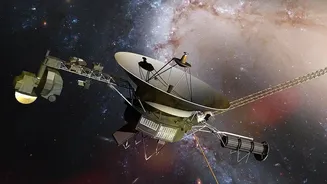
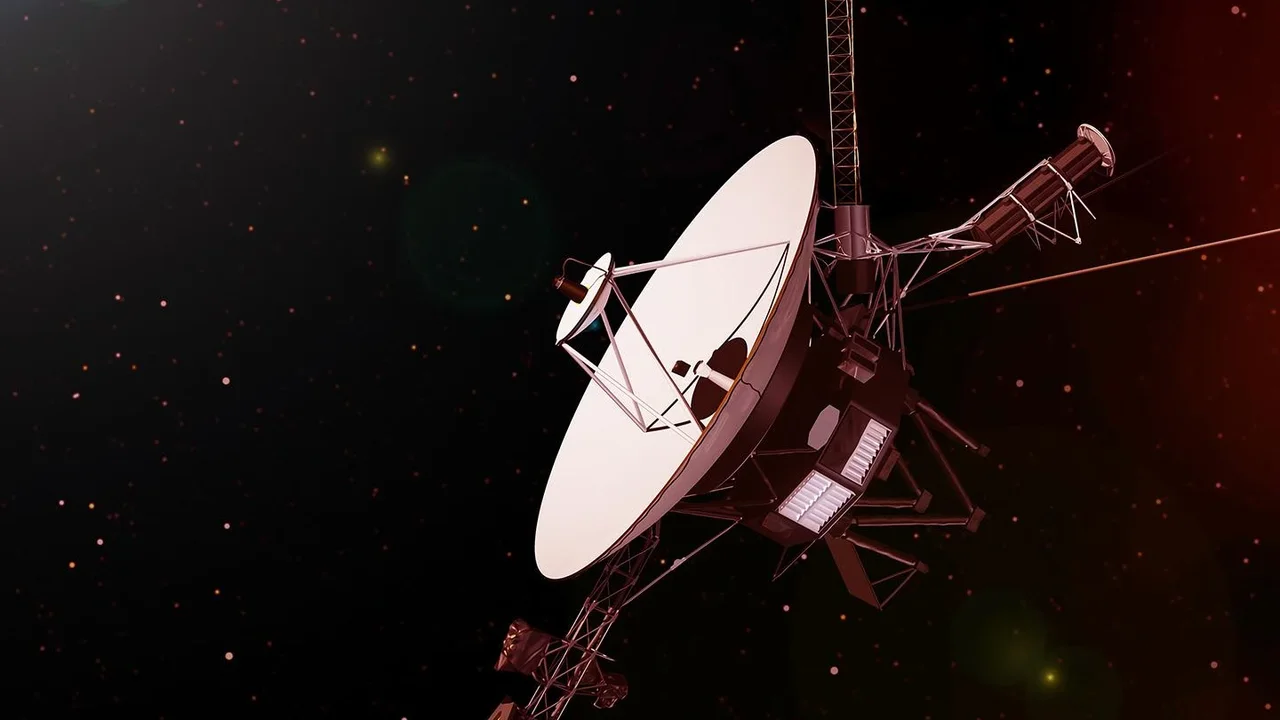
Enceladus offered scientists a more direct method: it shoots samples of its ocean into space. The moon is famous for the giant plumes of water vapor and ice particles that erupt from fractures near its south pole, nicknamed 'tiger stripes'. The Cassini spacecraft was able to fly directly through these plumes on multiple occasions, using its instruments to 'taste' their chemical composition. The results were astonishing. Cassini's mass spectrometer detected water vapor, ice particles, sodium chloride (table salt), and a variety of organic molecules. The salty composition confirmed the plumes originate from a liquid saltwater ocean. Later analysis even found molecular hydrogen, suggesting the presence of hydrothermal vents on the ocean floor—environments on Earth that teem with life.
The Next Generation of Ocean Hunters
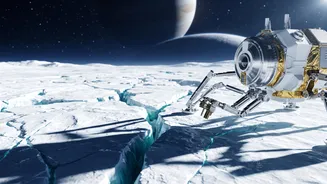
The pioneering work of missions like Cassini has paved the way for a new generation of probes designed specifically for ocean world exploration. NASA's Europa Clipper mission, for instance, is equipped with a sophisticated suite of instruments to investigate Jupiter's moon Europa. It carries an ice-penetrating radar called REASON, designed to measure the thickness of the ice shell and search for pockets of water within it. Its magnetometers will provide more precise measurements of the induced magnetic field, and its spectrometers will analyze any potential plumes and surface materials for chemical clues about the ocean below. These missions build on the proven techniques of gravity, magnetism, and chemical analysis to paint an even clearer picture of these hidden seas.