







The Legend of the Seven Pagodas
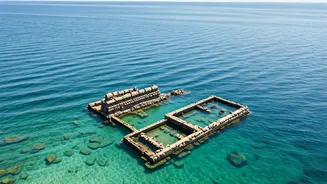
The story is an iconic piece of Indian folklore. Of the fabled ‘Seven Pagodas’ of Mahabalipuram, only one—the magnificent Shore Temple—stands today against the waves of the Bay of Bengal. Legend, passed down through generations of fishermen and recorded
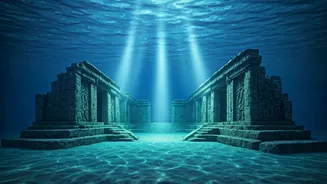
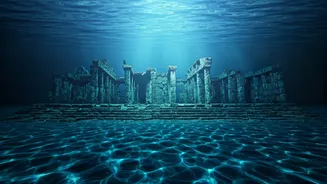
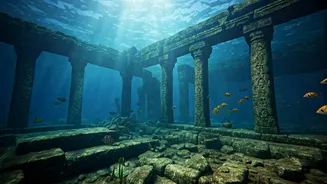
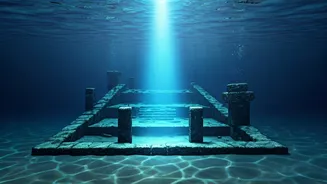
by early European travelers, insists that six other temples once shared the coastline. They were said to be so beautiful that the gods grew jealous and unleashed the sea to swallow them. For centuries, this tale remained firmly in the realm of myth, a romantic story about a glorious past lost to the ocean. It was a narrative that felt more like poetry than history, a testament to the grandeur of the Pallava dynasty that ruled from this port city in the 7th and 8th centuries.
A Tsunami's Shocking Revelation
The line between myth and reality blurred dramatically on December 26, 2004. As the Indian Ocean tsunami tragically struck the coast, the sea off Mahabalipuram pulled back by as much as 500 meters. In that terrifying, fleeting moment, local residents and tourists witnessed an unbelievable sight: a long, straight row of large rocks and what appeared to be the ruins of ancient structures emerged from the seabed. As the tsunami waves crashed ashore, the structures were submerged once more, but not before being seen by dozens of eyewitnesses. This event provided startling, tangible evidence that the legends might be true. The receding waters had not only exposed potential ruins but had also washed away centuries of sediment, making future exploration a tantalizing possibility.
Previous Dives and Discoveries
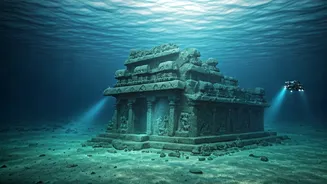
Spurred by the tsunami's revelation and earlier efforts, several underwater explorations have taken place over the years. In the early 2000s, scientists from the National Institute of Oceanography (NIO) and their collaborators found evidence of submerged walls and man-made structures. Then, in the months following the tsunami, the Archaeological Survey of India (ASI) and the Indian Navy launched a major expedition using sonar. Their efforts paid off. They discovered the remains of a massive wall, nearly 70 metres long. They also located remnants of two other submerged temples and a cave temple, all within 500 metres of the shore. These findings proved conclusively that a large temple complex had indeed been consumed by the sea, though its full extent remained a mystery.
A New High-Tech Quest Begins
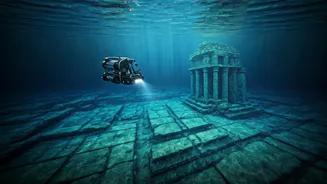
After a hiatus of nearly two decades, the ASI's Underwater Archaeology Wing has officially resumed its exploration of the Mahabalipuram coast. This new phase is not just a repeat of past efforts; it comes armed with powerful new tools. The team is now equipped with advanced sonar and, most notably, a Remotely Operated Vehicle (ROV). This submersible drone can capture high-resolution images and videos of the seabed without physically disturbing the delicate, submerged remains. It allows archaeologists to explore deeper and more challenging environments with greater safety and precision than ever before. The mission's goal is to build upon the discoveries of the past two decades and systematically map the underwater heritage site, hoping to finally solve the riddle of the Pallava-era structures that have been hidden for centuries.