







What Makes a World 'Superhabitable'?
For decades, our search for extraterrestrial life has been guided by the 'habitable zone'—the orbital ring around a star where it's not too hot and not too cold for liquid water to exist on a planet's surface. This has led to a focus on finding Earth-like
planets orbiting Sun-like stars. But a growing number of astrobiologists, pioneered by researchers like Dirk Schulze-Makuch, are challenging this Earth-centric view. They propose the concept of superhabitable worlds: planets that are theoretically more suitable for the emergence and evolution of complex life than our own. It’s not about finding a copy of Earth, but about identifying the key ingredients for a thriving biosphere and then turning those dials up to eleven. These worlds would be older, slightly larger, and a bit warmer than Earth, offering more stability and richer biodiversity over cosmic timescales.
The Ideal Planetary Profile
So, what does a planet need to be considered 'super'? First, it should be older than Earth. Our planet is about 4.5 billion years old, but complex life took nearly 4 billion years to get going. An older planet, perhaps between 5 to 8 billion years old, would have had more time for life to arise and diversify. Second, it should be slightly more massive—up to 1.5 times Earth's mass. This would mean stronger gravity to hold onto a thicker atmosphere, offering better protection from harmful cosmic rays. A larger size also means more retained internal heat, driving long-term geological activity like plate tectonics. Finally, a superhabitable world would be slightly warmer, with an average surface temperature around 25°C. This would create larger, more stable tropical zones, which on Earth are hotspots of biodiversity.
A Better Sun Than Our Own
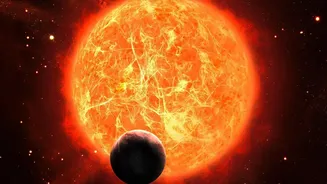
It’s not just about the planet; the host star matters immensely. Our Sun is a G-type star, which is relatively short-lived in cosmic terms, with a lifespan of about 10 billion years. K-type dwarf stars, which are slightly cooler, less massive, and more reddish than our Sun, are considered far better hosts. They can live for 20 to 70 billion years, offering an incredibly long and stable period for life to evolve. They also emit less intense UV radiation, which can be damaging to life. This incredible stability means a planet orbiting a K-dwarf star in its habitable zone has a much longer, safer window to develop a complex biosphere. A 2020 study identified 24 potential superhabitable planet candidates, with many orbiting these more favourable K-dwarf stars.
The 'Water World' Paradox
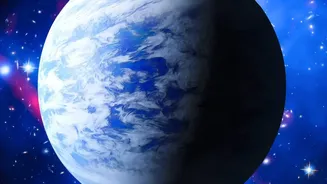
This brings us to water. The mantra 'follow the water' has long guided our search for life. It’s logical to assume, then, that a 'water world'—a planet completely covered by a deep, global ocean—would be the ultimate paradise. However, scientific models suggest the opposite might be true. While water is essential, an excess of it can be a problem. On Earth, life depends on crucial biogeochemical cycles. For example, phosphorus, a vital nutrient, is eroded from rocks on land and washed into the oceans, where it feeds marine life. A planet with no land would lack this critical nutrient pathway, potentially becoming a vast, sterile 'marine desert'. Without the land-sea interfaces and shallow continental shelves that foster immense biodiversity on Earth, a water world might struggle to support a complex ecosystem. The very geological activity that regulates our climate, like volcanism, could also be suppressed under the immense pressure of a deep global ocean.