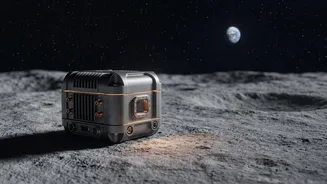








The Unforgiving Lunar Night
A lunar night lasts for about 14 Earth days. Without an atmosphere to hold onto heat, the surface temperature plummets to levels cold enough to freeze batteries and shatter electronics. Most solar-powered rovers simply power down and hope for the best,
a gamble that often ends their missions prematurely. The traditional solution has been to use Radioisotope Heater Units, or RHUs. These small devices use the natural decay of a plutonium pellet to generate a steady one watt of heat, keeping essential components warm. While effective, RHUs are a finite resource, relying on materials that are complex to produce and handle. They are always 'on', which means during the hot lunar day, that extra heat needs to be dissipated.
A Clever Thermal Switch
Now, a breakthrough from researchers at Nagoya University in Japan, collaborating with the Japan Aerospace Exploration Agency (JAXA), offers a more elegant and efficient solution. They have developed a 'heat-switch' device that acts as both a cooling system and an insulator, adapting to the Moon's wild temperature swings. This new system combines two key pieces of technology: a loop heat pipe (LHP) and an electrohydrodynamic (EHD) pump. Think of it as a smart thermostat that requires almost no power to operate.
How It Works: Day vs. Night
During the blistering lunar day, a rover's electronics generate a lot of heat that needs to be removed. The loop heat pipe works like a refrigerator, using a refrigerant fluid to absorb this heat, turn into a vapor, and carry it away to a radiator where it cools and turns back into a liquid. The key innovation is what happens at night. To survive the cold, the rover needs to stop losing heat. The team's solution is to activate the electrohydrodynamic pump. This pump creates an electric field that effectively stops the refrigerant from flowing, essentially 'switching off' the cooling system. This provides complete insulation, trapping the rover's residual warmth and protecting its electronics from the deadly cold with minimal electricity use.
The Impact for Future Exploration
This technology is a game-changer for lunar exploration. According to lead researcher Masahito Nishikawara, this heat-switch is essential for long-term missions. By ensuring rovers can reliably survive multiple lunar nights, it extends their operational lifespan from a couple of weeks to potentially months or even years. This allows for much more ambitious science. Rovers could travel further, study geological processes that unfold over time, and venture into permanently shadowed regions at the poles, which are thought to contain water ice but are also among the coldest places in the solar system. This technology is not just about survival; it's about enabling a persistent presence on the Moon. It reduces the reliance on costly and complex nuclear heaters and saves precious battery power that can be used for science and communication instead.