




A New Blueprint for Deep Space
For decades, NASA designed, built, and operated its own spacecraft. The Space Shuttle was a government program from start to finish. But that model is changing. The agency has increasingly adopted a public-private partnership (PPP) model, most notably
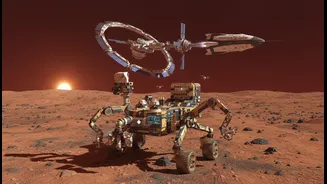
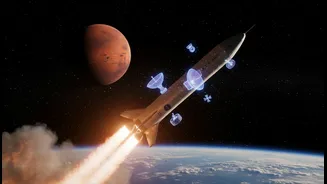
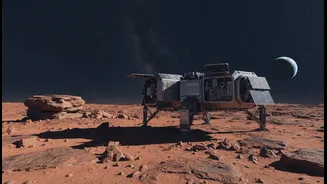
with the Commercial Crew and Cargo programs that resupply the International Space Station (ISS). In this setup, NASA acts as a customer, purchasing services from companies like SpaceX. This approach has successfully lowered the cost of accessing low-Earth orbit and allowed NASA to focus its resources on bigger goals, like returning to the Moon and, eventually, Mars. Building on this success, NASA is extending the model into deep space, recently announcing a partnership with Relativity Space for a robotic Mars mission called Aeolus, set to launch in 2028. NASA will provide the scientific instruments, while the private company will handle the rocket, spacecraft, and mission operations. This strategy is seen as a 'force multiplier' that can increase the frequency of missions and accelerate discovery.
The Sobering Realities of Mars
While the PPP model worked for the ISS, Mars is an entirely different challenge. The risks are exponentially greater. A trip to Mars is not a few days in low-Earth orbit; it's a multi-year journey into deep space, exposing astronauts to significant radiation and the physiological toll of long-term microgravity, such as bone density loss and muscle atrophy. The technical hurdles are immense, from developing reliable long-duration life support systems to landing a heavy crewed vehicle on a planet with a thin atmosphere. Unlike resupplying the ISS, where a cargo mission failure is acceptable as long as it doesn't endanger the station, any failure in a crewed Mars mission could be catastrophic. These missions require immense upfront investment for technologies that have no other market, making the financial risks as daunting as the technical ones. The sheer number of unknowns means that traditional, fixed-price contracts common in commercial ventures become difficult to implement.
The Peril of 'Cost Optimism'
Private aerospace companies bring incredible innovation and efficiency, often promising to achieve ambitious goals for a fraction of the cost of legacy government programs. This is 'commercial-cost optimism'—the belief that nimble, private-sector methods can overcome challenges that have historically led to massive cost overruns in government-led projects. While this optimism drives progress, it can also be a double-edged sword. The aerospace industry is known for its ambitious projections, with both demand and production targets often facing delays due to supply chain issues and unforeseen complexity. The Commercial Crew Program itself provides a cautionary tale. While SpaceX has successfully flown numerous missions, Boeing's Starliner program has been plagued by years of delays, technical issues, and significant cost increases, far exceeding its original fixed-price contract. NASA's own Inspector General noted the agency was initially overconfident in Boeing's ability to meet its aggressive schedule. For a mission as complex as Mars, relying too heavily on optimistic cost projections could lead to critical funding shortfalls and mission compromises down the line.
Sharing the Risk, Defining the Reward
A successful Mars partnership hinges on how risk is truly shared. It's not just about splitting the bill. It's about creating contracts that can adapt to the unknown challenges of deep space. Who is financially responsible when a new technical problem requires years of extra research and development? How are intellectual property rights for new technologies divided? Conflicts of interest between a company's need for profitability and the government's public service and safety goals are inherent challenges in any PPP. For Mars, these conflicts are magnified. A successful model cannot simply offload risk onto the private partner, whose financial model may not be able to absorb a decade of unforeseen costs. Nor can it leave the taxpayer to foot the bill for every overage. The key may lie in a hybrid approach that blends the fixed-price service model with the flexibility of older 'cost-plus' contracts, where NASA shared more of the development risk. This requires a new level of transparency and collaboration, moving beyond a simple customer-vendor relationship.