


More Than Just Walking with Sticks
Originating in Finland as off-season training for cross-country skiers, Nordic walking uses specially designed poles to turn a regular walk into a full-body workout. Unlike trekking poles, which are primarily for stability on uneven terrain, Nordic poles are designed to propel
you forward. This simple addition engages your upper body, including your arms, shoulders, and core, activating up to 90% of your body's muscles compared to about 50% with regular walking. The result is a more efficient and comprehensive exercise that has been shown to burn up to 46% more calories than walking without poles.
Why It's Gaining Popularity in India
The renewed interest in Nordic walking is driven by its accessibility and significant health benefits. It's a joint-friendly exercise, as the poles help reduce the impact on knees and hips, making it suitable for all ages and fitness levels. In India, organisations are now working to promote the activity through certified instructors and community programmes, highlighting its advantages for heart health, weight management, and improved posture. Studies have shown it can improve cardiovascular fitness, reduce 'bad' LDL cholesterol, and even help with conditions like chronic pain and anxiety.
Choosing the Right Poles
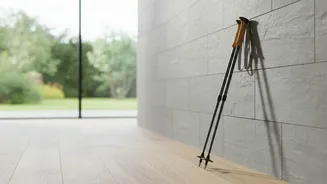
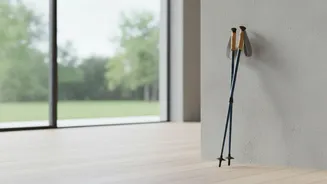
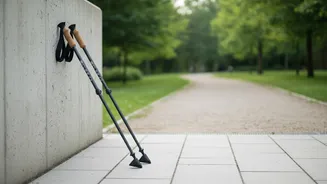
Before you can master the technique, you need the right equipment. It's crucial to use poles designed specifically for Nordic walking, not trekking or skiing. Look for lightweight poles with comfortable, glove-like straps that allow you to push off effectively. For length, a common rule is to multiply your height in centimetres by 0.68. Alternatively, when you hold the pole, your elbow should form a 90-degree angle. While some prefer fixed-length poles for being lighter, adjustable poles are great for beginners, for sharing, or for travel.
Mastering the Basic Technique
The core of Nordic walking is a coordinated, rhythmic movement. The key is to walk naturally, swinging your arms from the shoulder in opposition to your legs—left arm forward with right leg, and right arm forward with left leg. Keep your posture upright, chest open, and look ahead. The poles should be an extension of your arms, angled backward at roughly 45 degrees. As you step forward with one foot, plant the opposite pole on the ground between your front and back foot. The movement should feel fluid and propulsive, not like you're just carrying the poles.
Perfecting the Push-Off and Hand Release
The real power in Nordic walking comes from the push-off. As your arm swings backward, straighten it and push firmly through the pole strap to propel your body forward. This engages your triceps and back muscles. A key part of advanced technique involves relaxing your grip as your arm moves behind you, opening your hand to let the pole swing forward from the strap. As your arm comes forward again for the next stride, you regrip the pole. This 'plant, push, release' cycle is what creates a powerful and efficient stride, maximising the upper-body workout.
Common Mistakes to Avoid
Many beginners make a few common errors that reduce the effectiveness of the workout. One major mistake is planting the pole too far in front of the body, which acts as a brake instead of a propeller. Another is using the wrists and elbows instead of swinging from the shoulder, which limits muscle engagement and can cause strain. Also, avoid a hunched posture; keeping your back straight is essential to get the full benefits. Finally, ensure your poles are the correct length. If they are too short, you will bend forward, and if they are too long, it can strain your shoulders.