

Why All Eyes Are on Europa
For decades, Jupiter's moon Europa has captivated scientists. Data from previous missions, like the Galileo spacecraft in the 1990s, provided strong evidence that a massive ocean of liquid saltwater is churning beneath its frozen surface. This isn't just
a small pocket of water; estimates suggest Europa’s ocean could contain twice as much water as all of Earth's oceans combined. What makes this so compelling is the presence of water, a key ingredient for life as we know it. The moon's surface is the smoothest solid body in the solar system, suggesting it is geologically young and active, constantly reshaped by the ocean below. This activity is driven by tidal heating—gravitational tugs from Jupiter that flex the moon's interior, generating enough warmth to keep its hidden ocean liquid.
Meet the Clipper: A Robotic Explorer
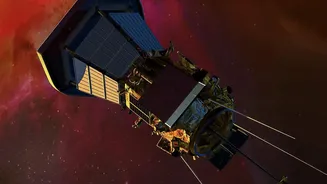
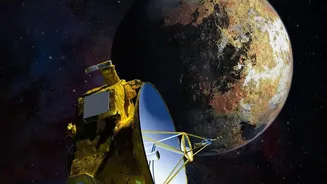
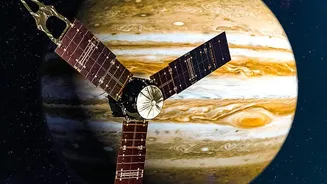
To investigate this tantalizing world, NASA has dispatched the Europa Clipper, the largest spacecraft ever developed for an interplanetary mission. Launched in October 2024, the craft is currently on a multi-year journey to the Jupiter system. To protect its sensitive electronics from Jupiter's intense radiation, the instruments are housed within a heavily shielded aluminum-titanium vault. The spacecraft is equipped with a sophisticated suite of nine scientific instruments designed to act as our eyes, ears, and hands. These include high-resolution cameras to map the surface, an ice-penetrating radar to measure the thickness of the ice shell, and spectrometers to identify the chemical composition of surface materials and Europa's thin atmosphere.
A Long Journey and a Clever Plan
Reaching Jupiter, over a billion miles away, requires a clever flight path. The Europa Clipper is using gravity assists from Mars (in March 2025) and Earth (in December 2026) to slingshot itself toward the outer solar system. It is scheduled to arrive in orbit around Jupiter in April 2030. Instead of orbiting Europa directly, which would expose it to the harshest radiation, the Clipper will enter a long, looping orbit around Jupiter. From there, it will perform nearly 50 close flybys of Europa, swooping down to altitudes as low as 25 kilometers. This strategy allows the spacecraft to gather detailed measurements from different regions of the moon while minimizing radiation damage, extending the life of the mission.
The Search for Ingredients, Not Life
A crucial point about the Europa Clipper mission is that it is not designed to find life itself. Instead, its primary goal is to determine if Europa is habitable—that is, if it has the necessary ingredients for life to exist. These ingredients are broadly defined as liquid water, essential chemical elements (like carbon, hydrogen, nitrogen, oxygen, phosphorus, and sulfur), and a source of energy. Scientists believe Europa has the water. The Clipper will investigate the chemistry by analyzing surface materials and any potential water plumes that might erupt into space. Energy could come from the tidal heating and chemical reactions at the seafloor, similar to the hydrothermal vents on Earth's ocean floors that support entire ecosystems without sunlight. By assessing these three key areas, the mission will tell us if Europa is, or ever was, a place where life could thrive.