



Starlight as a Messenger
Imagine a bright light bulb with a tiny, translucent gnat flying in front of it. As the gnat passes, the light dims slightly, but some of it also filters through its wings, changing color ever so faintly. This is the basic principle behind a technique
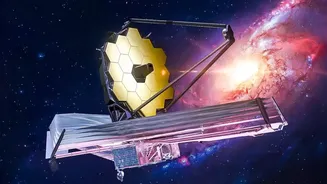
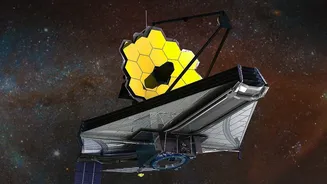
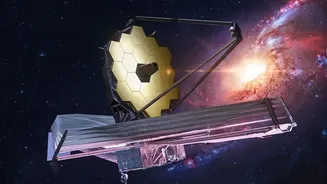
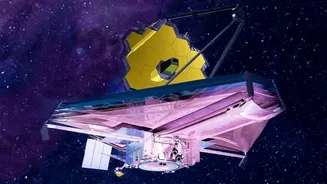
called transit spectroscopy, which the James Webb Space Telescope (JWST) uses to study exoplanets. When a distant planet passes, or transits, in front of its host star from our point of view, the starlight passes through the planet's atmosphere. JWST’s highly sensitive instruments capture this light. For a brief moment, that planet’s atmosphere is backlit, giving astronomers a precious opportunity to read the starlight that has been filtered through it. This method turns starlight into a messenger carrying secrets from another world.
The Infrared Advantage
Previous telescopes, like Hubble, could perform this technique, but JWST is a game-changer because it is optimized to see the universe in infrared light. This is crucial for studying atmospheres. Many of the molecules scientists are most interested in—like water vapor, methane, and carbon dioxide—happen to be very good at absorbing specific frequencies of infrared light. Visible light might pass through them without leaving much of a trace, but in the infrared spectrum, their presence is obvious. By focusing on this part of the light spectrum, JWST can detect the chemical fingerprints of these key compounds with unprecedented clarity, even in the faint light from a star hundreds or thousands of light-years from Earth. It's like having a new pair of glasses that lets you see the clues everyone else missed.
Decoding a Planet’s Chemical Barcode
When the starlight passes through an exoplanet's atmosphere, the gases present act like a chemical filter. Each type of molecule—water, methane, carbon dioxide—absorbs very specific wavelengths of light. When JWST’s spectrographs spread the incoming starlight into its full spectrum, like a prism creating a rainbow, these absorbed wavelengths show up as dark lines. The resulting pattern of lines is unique to each atmosphere’s chemical makeup, effectively creating a 'chemical barcode' for that world. By analyzing which 'colors' are missing from the starlight, scientists can definitively identify the gases present. This technique is so precise that it has already allowed astronomers to confirm the presence of water vapor on the gas giant WASP-96b and carbon dioxide on another, WASP-39b.
The Search for Biosignatures
The ultimate goal, of course, is to find signs of life. Scientists aren't looking for aliens waving back, but for 'biosignatures'—gases that are likely produced by biological processes. On Earth, the combination of abundant oxygen and methane is a strong indicator of life. Methane is produced by microbes, and oxygen is a byproduct of photosynthesis. Finding both together in a planet's atmosphere could be a compelling sign of biology, as they tend to destroy each other without a constant source to replenish them. However, scientists are extremely cautious. Many of these gases can also be created by geological or chemical processes without any life involved, creating potential false positives. A recent tentative detection of dimethyl sulfide on the planet K2-18b—a gas only produced by life on Earth—generated excitement, but requires much more observation to be confirmed.
From Giant Planets to Rocky Worlds
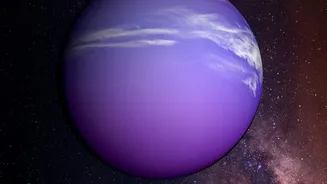
So far, JWST has primarily focused on the atmospheres of 'hot Jupiters'—large, gaseous planets orbiting very close to their stars. Their puffy, expansive atmospheres make them easier targets for analysis and have provided crucial proof that the technology works. These early studies have revealed complex weather patterns, atmospheric escape where planets are stripped of their gases, and even unexpected water-ice clouds on a Jupiter-like world. The next frontier is to apply these same techniques to smaller, rocky planets similar in size to Earth that orbit within their star's habitable zone—the region where liquid water could potentially exist on the surface. These observations are incredibly challenging, as the atmospheres are much thinner, but they hold the greatest promise for answering the age-old question: are we alone?