


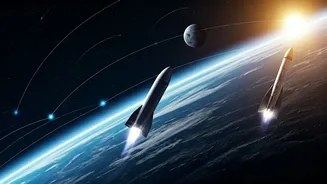



A Crowded Cosmos
The 21st-century space race is defined by a diverse set of players. National agencies like NASA in the US, China's CNSA, and India's ISRO are no longer the only actors. [16] They are now joined—and sometimes challenged—by ambitious private companies such
as SpaceX and Blue Origin. [7] This mix of government-funded national prestige projects and profit-driven commercial enterprise has created a dynamic and competitive environment. While the US and China are often seen as the main rivals, India, Japan, the UAE, and Europe are also carving out significant roles. [21, 27] India, for instance, is planning an ambitious slate of missions, including uncrewed Gaganyaan flights, aiming for 50 launches in the next five years. [8, 9] China, aiming for a crewed lunar landing by 2030, is integrating its robotic and human spaceflight programs and developing a new suite of powerful rockets and spacecraft like the Long March 10 and the Mengzhou crew vehicle. [15, 29, 30]
The Red Planet: A Common Goal
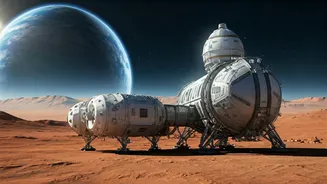
Mars remains the ultimate destination, a powerful symbol of humanity's exploratory drive. [18] NASA has long stated that the Red Planet is the ultimate goal of its human exploration program. [18] China is also looking toward Mars, with plans to send its first astronauts by 2033 after successfully landing its Zhurong rover. [18] Private industry is equally captivated; SpaceX was founded with the explicit goal of making humanity multi-planetary, with founder Elon Musk aiming for cargo flights to Mars starting no earlier than 2028. [31, 20] These missions aren't just for prestige. They are driven by scientific curiosity about the planet's potential for past life and the development of technologies needed for long-duration space travel. [18]
The Moon: A Critical Staging Post
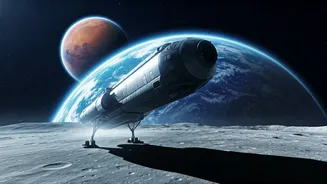
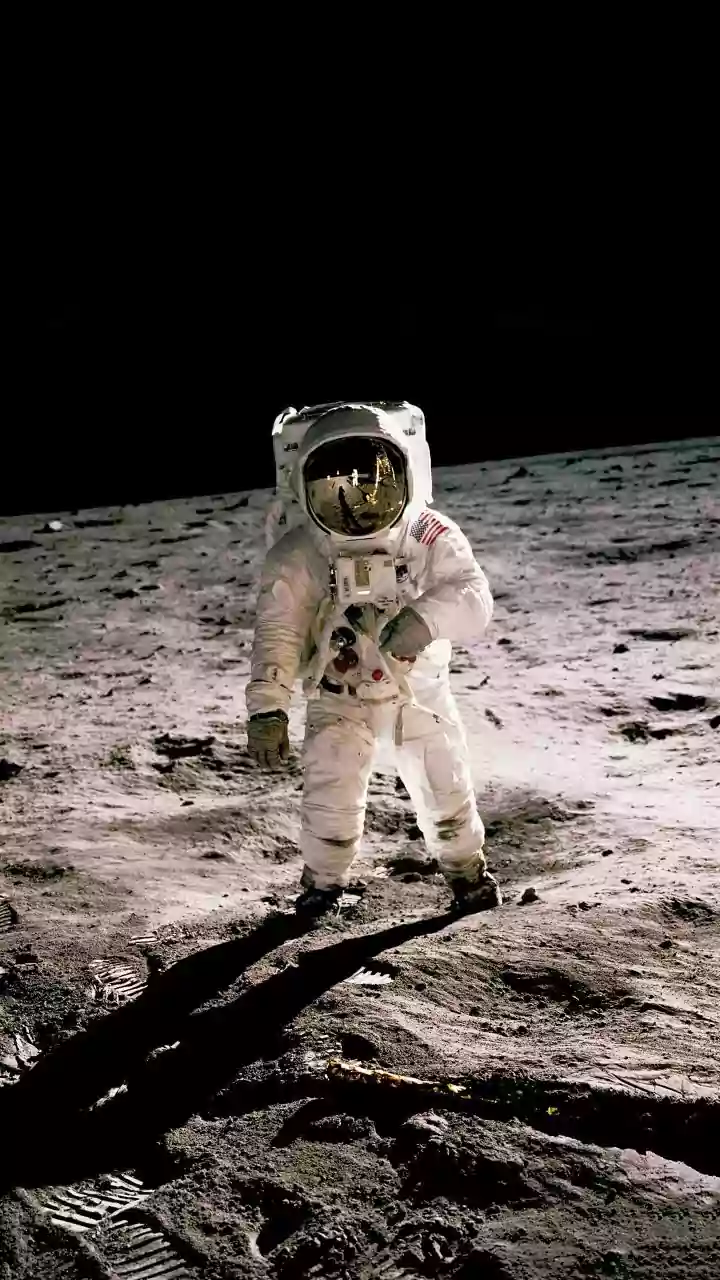
Before we get to Mars, nearly all roads lead through the Moon. It's seen as an essential training ground and stepping stone for deeper space missions. NASA's Artemis program aims to establish a sustainable human presence on and around the Moon. [24] However, the program has faced delays; the crewed Artemis II lunar fly-by is now scheduled for April 2026, with the first landing—Artemis IV—pushed to early 2028. [3, 6] NASA has also revised its plans, inserting a new mission, Artemis III, in 2027 to test docking with commercial lunar landers in Earth orbit. [5, 14] China is also targeting the Moon's south pole for a research station, with plans for a basic station by 2035. [26] India is collaborating with Japan on the LUPEX mission to explore for water ice near the lunar south pole. [10]
Competition, Collaboration, and Commercialization
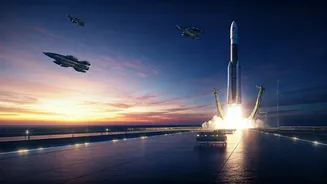
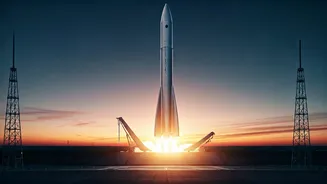
This new era is not just a race between nations but also a thriving marketplace. The economics of space access have been fundamentally altered by reusable launch systems, pioneered by SpaceX with its Falcon 9 and the in-development Starship. [4] Starship, designed to be fully reusable, aims to drastically lower launch costs, making ambitious projects like mega-constellations and Mars colonization more feasible. [4, 13] The most recent Starship test in May 2026 demonstrated mock satellite deployment and a controlled splashdown, showing progress despite a booster mishap. [20, 4] This commercial boom has led to a surge in space startups, with India alone seeing a jump from one in 2014 to over 400 by early 2026. [21] But geopolitical tensions are ever-present. The US and China are on separate, competing tracks to the Moon, with NASA Administrator Jared Isaacman framing it as a race the US cannot afford to lose. [26]
Why Race? The Stakes on Earth
The motivations behind this new space rush are complex, blending scientific ambition with terrestrial concerns. [16] National pride is a powerful driver, just as it was in the 20th century. But today, the economic and strategic stakes are much clearer. Space is now critical infrastructure, underpinning everything from GPS and weather forecasting to global finance and communications. [16] Consequently, sovereignty and security have become major drivers of investment. [27] Nations are building up their own satellite constellations for communication and Earth observation, and commercial capabilities are increasingly integrated into national security frameworks. [27, 28] The pursuit of a permanent lunar base or a mission to Mars is not just about exploration; it's about developing the technological muscle, economic capacity, and strategic influence that will define the 21st century and beyond.