



The Constant Battle Against Drag
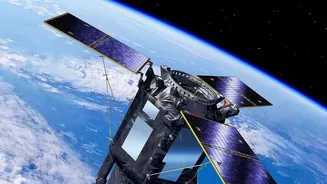
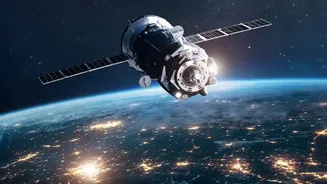
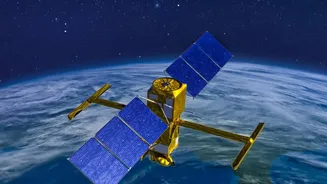
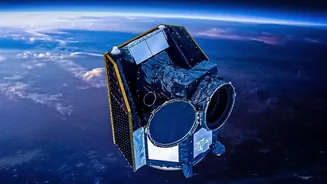
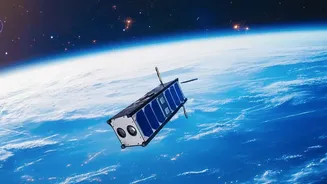
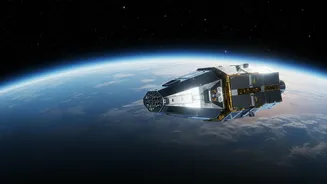
Satellites in low-Earth orbit (LEO), an area extending up to about 2,000 kilometers, are crucial for everything from high-speed internet to climate monitoring. But this orbital region isn't a perfect vacuum. It contains faint traces of atmosphere that,
while incredibly thin, exert a persistent drag force on anything moving through them at 28,000 km/h. This friction acts like a constant brake, causing the satellite's orbit to gradually shrink, a process known as orbital decay. Without periodic boosts to a higher altitude, every LEO satellite will eventually be pulled back into the denser atmosphere and burn up. The lower the orbit, the stronger the drag and the faster the decay; a satellite at 300 km might only last for a few months without propulsion. The International Space Station, for example, requires regular re-boosts to counteract this effect and maintain its altitude.
The Problem with Onboard Fuel
The traditional solution to orbital decay is to equip satellites with their own propulsion systems and a finite tank of fuel, like xenon or hydrazine. These thrusters fire periodically to give the satellite a nudge, pushing it back up to its desired altitude. While effective, this approach has a fundamental limitation: when the fuel runs out, the mission is essentially over. The satellite can no longer fight against drag, and its operational life is capped by how much propellant it can carry. This not only limits the return on a very expensive investment but also contributes to the growing problem of space debris, as defunct satellites become uncontrolled objects in an already crowded environment. Furthermore, the mass of the fuel itself makes the satellite heavier and more expensive to launch in the first place.
A Revolutionary Breath of Fresh Air
Enter air-breathing electric propulsion (ABEP), a game-changing technology that aims to solve the fuel problem entirely. Instead of carrying a limited supply of propellant, an ABEP system ingests the residual atmospheric molecules that cause drag and uses them as fuel. This clever concept turns the problem—atmospheric drag—into the solution. By harnessing an essentially limitless resource from its environment, a satellite with an air-breathing engine could theoretically operate indefinitely, compensating for drag for as long as its solar panels and electronics function. This could enable a new class of long-duration missions, especially in very low-Earth orbits (VLEO), from 150 to 400 km, where the benefits of being closer to Earth (like higher-resolution imaging and lower-latency communications) are greatest, but the drag is most intense.
How Air-Breathing Tech Works
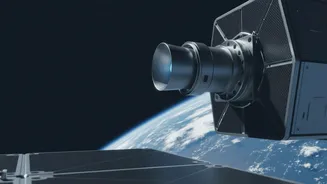
The principle behind ABEP is both elegant and complex. A specially designed intake at the front of the satellite scoops up the scarce atmospheric particles. These particles, instead of just bouncing off, are collected and channeled into an electric thruster. Inside the thruster, the captured air molecules—mostly atomic oxygen and nitrogen at these altitudes—are ionized, meaning they are given an electrical charge. Once charged, these ions can be accelerated by electromagnetic fields and expelled at extremely high velocity, generating a small but continuous thrust. This thrust is precisely calculated to counteract the drag force, allowing the satellite to maintain a stable orbit without using any stored propellant. The entire system is powered by the satellite's solar arrays, making it a sustainable, self-fueling machine.
The Future of Sustainable Orbits
The implications of this technology are vast. For satellite operators, it means longer mission lifespans and a better return on investment. For services like satellite internet and Earth observation, it promises uninterrupted operations and potentially lower costs for consumers. The technology is currently under active development by space agencies and private companies worldwide, including the European Space Agency and US-based firms like Phase Four, which has a contract with DARPA. India's space program is also exploring the technology. While technical hurdles remain, the first on-ground tests have been successful, proving the concept is viable. As we deploy more and more satellites, the ability to keep them operational for longer and reduce the creation of space junk will be critical. Air-breathing propulsion represents a major step toward a more sustainable and efficient use of low-Earth orbit.