


Analyse The Object's Path
The first major clue is the object's trajectory. Natural meteoroids, originating from the asteroid belt or comets, enter Earth's atmosphere at incredibly high speeds—anywhere from 11 to 72 kilometres per second. They often arrive at steep angles. In contrast,
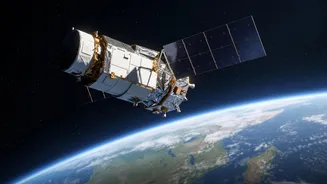
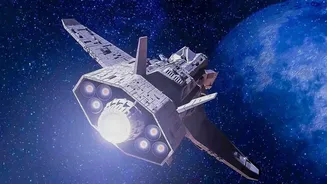
human-made space debris, like a defunct satellite, is already in orbit around our planet. Its return is more of a gradual decay. These objects re-enter the atmosphere at much lower speeds and shallower angles, often leading to a slower, longer-lasting light show that can traverse a large portion of the sky. While a meteor flashes and disappears in seconds, space junk might be visible for a minute or more.
Check Its Known Whereabouts
One of the most straightforward methods of identification is checking databases. International bodies like the United States Space Surveillance Network track thousands of objects larger than a softball. When a satellite is decommissioned or a rocket stage is expected to re-enter the atmosphere, its orbital path is generally known. If a fiery event in the sky corresponds with the predicted re-entry time and location of a tracked piece of space junk, the case is often closed. This process of elimination helps to quickly identify many falling objects as man-made before any physical analysis is even possible.
Examine The Material Composition
If a fragment survives the fiery descent and is recovered on the ground, its composition tells a definitive story. Meteorites are broadly categorised as stony, iron, or stony-iron. Stony meteorites, the most common type, are primarily made of silicate minerals like olivine and pyroxene and often contain unique, tiny spherical particles called chondrules, which are not found in Earth rocks. Iron meteorites are composed of a dense iron-nickel alloy. Man-made objects, on the other hand, are built from modern materials. Satellites and rockets use alloys of aluminium and titanium, along with composites, wiring, solar panels, and other manufactured components that are distinctly different from the natural makeup of a space rock. Finding a piece of titanium alloy or a circuit board is a dead giveaway of human origin.
Look For A Fusion Crust
One of the most telling features of a meteorite is its fusion crust. As a meteoroid plummets through the atmosphere, the intense heat from air compression melts its exterior. Upon slowing down, this molten layer cools and solidifies into a thin, glassy coating, typically black or dark brown. This crust is rarely more than a millimetre or two thick and can sometimes flake off. Man-made objects also heat up and melt during re-entry, but they don't form the same distinct, uniform crust. Instead, pieces of space junk will show signs of melting, charring, and twisting consistent with the destruction of manufactured components like metal panels and trusses, not the ablation of a solid rock.
Other Clues On The Ground
Beyond the crust, scientists look for other physical signs. Many meteorites are magnetic due to their iron-nickel content. Iron meteorites specifically can have an irregular shape with pits resembling thumbprints, called regmaglypts, which form as the surface melts during flight. The interior of a stony meteorite often reveals a different colour and texture from its dark exterior, sometimes showing metallic flecks scattered within a rocky matrix. Conversely, pieces of space debris are more likely to be hollow, twisted, or have sharp, unnatural edges. They won't contain the primitive minerals or show the specific crystalline structures that are hallmarks of rocks that have spent billions of years in space.