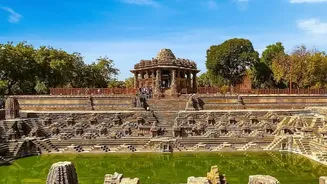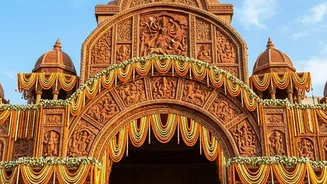



In Odisha, a land where ancient stories are etched in stone, the Konark Sun Temple stands as a monumental wonder. This 13th-century marvel is not just a temple but a grand narrative of devotion, science, and art, waiting to be decoded.
A Colossal Chariot for the Sun God
Imagine a gigantic
chariot, 100 feet high, frozen in stone as it prepares to carry the Sun God, Surya, across the heavens. This is the breathtaking vision of the Konark Sun Temple. Built around 1250 CE by King Narasimhadeva I of the Eastern Ganga dynasty, the temple is a crowning achievement of Kalinga architecture. Its name combines 'Kona' (corner) and 'Arka' (sun), reflecting its position to catch the sun's rays perfectly at dawn, noon, and sunset. The entire structure rests on 24 intricately carved wheels and is pulled by seven mighty horses, a grand design that turns Hindu iconography into a physical masterpiece. The seven horses are said to represent the days of the week, while the 12 pairs of wheels symbolize the months of the year, making the temple a cosmic calendar in stone.
The Wheels of Time
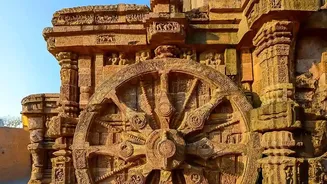
The 24 wheels of Konark are perhaps its most famous feature, and for good reason. Each wheel, nearly 10 feet in diameter, is a functional sundial, a testament to the advanced astronomical knowledge of its creators. The wheels are adorned with elaborate carvings, but their design is scientific. Each wheel has eight major spokes that divide the day into three-hour periods called 'prahars'. Between these are eight minor spokes, marking 90-minute intervals. The edge of the wheel features beads that can be used to calculate time down to the minute. By placing a finger or stick in the axle's hole, the shadow it casts reveals the time of day with remarkable accuracy. This blend of art and science is so iconic that the Konark wheel is featured on India's ten-rupee banknote.
A Library Carved in Stone
The temple's surfaces are a library of 13th-century life, meticulously carved into Khondalite stone. Artisans used this relatively soft stone for its ability to hold fine detail, while harder chlorite was used for key statues and laterite for the core foundation. The carvings depict a vast range of subjects. You can see detailed scenes of royal processions, military campaigns, and trade. There are also intimate portrayals of daily life: women cooking, musicians playing instruments, teachers with students, and farmers at work. These sculptures offer an invaluable glimpse into the social and cultural fabric of medieval Odisha. The walls are further populated by a menagerie of mythological creatures, celestial beings, and lifelike animals, including elephants and horses that symbolise power and energy.
The Guardians and Deities
Guarding the temple are monumental sculptures, each with its own deep symbolism. At the main entrance, two colossal stone lions are depicted crushing elephants, a motif known as 'Gajasimha'. This is often interpreted as a symbol of spiritual power overcoming worldly wealth and pride. Elsewhere, two beautifully carved war horses are shown trampling warriors, a powerful emblem of strength and energy that has been adopted as a symbol by the Government of Odisha. The temple also features three magnificent, life-sized statues of the Sun God Surya, strategically placed in different locations to catch the sun's rays at sunrise, noon, and sunset. These carvings represent different phases of the sun's life and energy, from the vibrant youth of the morning sun to the mature power of the midday sun.
The Enigma of the Erotic Carvings
Among the most discussed and debated features of Konark are its explicit erotic sculptures. Far from being mere decoration, these carvings are believed to hold deep philosophical meaning. One prominent theory connects them to Tantric beliefs, where the union of male and female energies ('purusha' and 'prakriti') is a metaphor for cosmic harmony and spiritual enlightenment. The sculptures, known as 'mithuna', are seen as a celebration of 'kama' (desire) as one of the essential pursuits of a balanced human life, to be transcended before one enters the inner sanctum to seek 'moksha' (liberation). Others suggest the carvings served a practical purpose, such as educating householders, or were believed to protect the temple from natural calamities like lightning.