


The Power of Invisible Light
To understand the James Webb Space Telescope's prowess, we first need to appreciate infrared light. Unlike visible light that our eyes can see, infrared is a range of light waves that we feel as heat. Many celestial objects, including cooler stars and distant
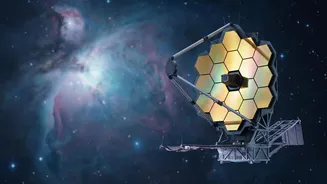
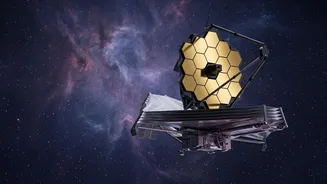
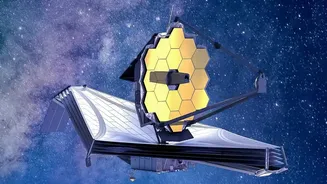
planets, shine brightest in the infrared spectrum. Critically, Earth's own atmosphere blocks much of this light, which is why a space-based observatory like the JWST is essential. By positioning itself far from Earth and using a massive 6.5-metre primary mirror, the JWST can capture faint infrared signals that have travelled across light-years of space, giving us a view of the cosmos that is impossible to get from the ground.
Decoding a Planet's Atmosphere
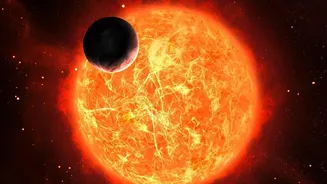
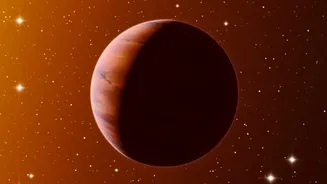
The primary method JWST uses is called transmission spectroscopy. When an exoplanet passes in front of its host star from our perspective, a tiny fraction of the starlight filters through the planet's atmosphere. Different gas molecules in that atmosphere absorb very specific colours, or wavelengths, of light. Water vapour, in particular, has a strong and recognisable absorption signature in the infrared range. This process leaves a 'fingerprint' in the starlight that reaches the telescope. By analysing which wavelengths are missing, scientists can determine precisely what gases, including water, are present in that alien world's air.
Webb's Specialist Toolkit
JWST is not a single tool but a suite of four highly advanced scientific instruments, each designed for specific tasks. For studying exoplanet atmospheres, the Near-Infrared Spectrograph (NIRSpec) and the Mid-Infrared Instrument (MIRI) are particularly vital. NIRSpec can observe in the near-infrared range from 0.6 to 5.3 microns, while MIRI covers the mid-infrared from 5 to 28 microns. Together, they provide comprehensive wavelength coverage. Water vapour has distinct features across this infrared spectrum. By combining data from these instruments, astronomers can create an incredibly detailed profile of a planet's atmosphere, confirming the presence of water with high confidence and even studying cloud composition, such as the silicate (sand) clouds found on WASP-107b.
A Leap Beyond Previous Telescopes
While the Hubble Space Telescope gave us tantalising hints of water on exoplanets, its capabilities were limited. JWST represents a monumental leap forward. Its mirror has a much larger light-collecting area, allowing it to gather more photons and achieve greater sensitivity. Furthermore, Hubble primarily observes in visible and ultraviolet light, with only limited near-infrared capability. JWST is specifically designed and optimised for infrared astronomy, making it far more sensitive to the subtle absorption lines created by water molecules. This specialisation allows it to detect even faint water signatures on smaller, rocky planets, a task that was previously impossible. Discoveries of water vapour on worlds like GJ 486 b and in planet-forming disks demonstrate this unprecedented sensitivity.