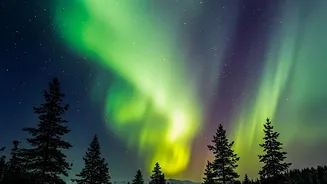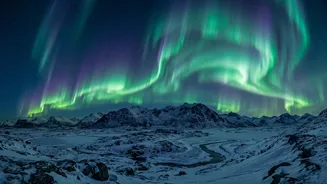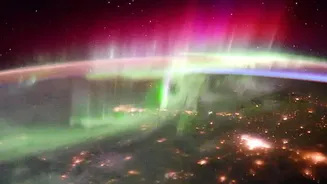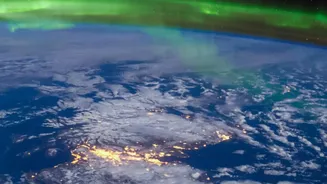



The aurora is one of nature's most dazzling shows, but the same space weather that paints the sky with light can send damaging electric currents surging through power grids. New research reveals this threat isn't uniform, but can vary dramatically.
A Threat from the Heavens
When
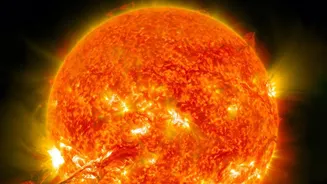
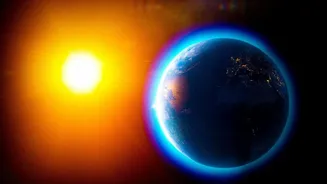
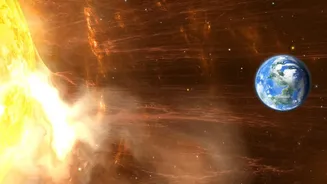
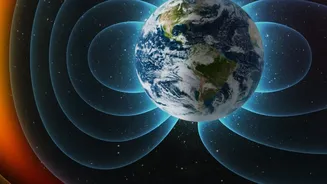
the sun ejects a massive cloud of charged particles, known as a coronal mass ejection (CME), it can trigger a geomagnetic storm on Earth. This interaction with our planet's magnetic field creates the beautiful aurora, but it also has an invisible, dangerous side effect. The storm causes rapid fluctuations in the Earth's magnetic field, which in turn induces powerful, low-frequency electrical currents in the ground. These are called geomagnetically induced currents, or GICs. These currents seek the path of least resistance, which often means surging into long conductors like pipelines and, crucially, high-voltage power transmission lines. Once inside a power grid, GICs can overload transformers, causing them to overheat, malfunction, or even suffer permanent damage. The most famous example is the 1989 blackout in Quebec, which left millions without power for hours due to a severe solar storm.
The Local Surprise
For years, the risk from GICs was assessed on a broad, regional scale. The thinking was that a large geomagnetic storm would create a relatively uniform threat across a wide area. However, a recent study highlights a more complex and localized reality. The research shows that the effects of a space weather event, known as a substorm, can differ sharply between nearby locations. The strength of the induced ground currents is not just dependent on the intensity of the solar storm overhead, but also on what lies beneath our feet. This means two towns located just a few dozen kilometres apart could face vastly different levels of risk from the very same cosmic disturbance.
Why Geology Is Key
The secret to this local variation lies in the ground's electrical conductivity. Different types of rock, soil, and underground water content conduct electricity differently. Where the ground is highly conductive, the geomagnetically induced currents can flow through the earth more easily. But in areas with poorly conducting rock, the electrical energy can't dissipate as effectively. In these locations, the ground essentially resists the flow of current, causing a stronger electric field to build up at the surface. This high-voltage potential then finds an easier path through man-made conductors, like the power grid, resulting in much stronger and more dangerous GICs in that specific area. This is why a region with resistive geology can experience a much more severe impact than a neighbouring area with more conductive ground.
A New Map for Grid Resilience
This new understanding has profound implications for how we protect our vital infrastructure. Instead of relying on broad, region-wide alerts, power grid operators now have a reason to develop more granular risk assessments. Scientists are using magnetotelluric surveys—a method that measures the Earth's natural electric and magnetic fields to map subsurface electrical properties—to create detailed, three-dimensional maps of ground conductivity. These maps can pinpoint specific zones of high and low risk with unprecedented accuracy. Armed with this knowledge, utility companies can better forecast which specific substations and transformers are most vulnerable during a solar storm. This allows them to take targeted protective measures, such as temporarily disconnecting sensitive equipment or rerouting power flows to avoid overloading the most at_risk components of the grid. It moves the strategy from simply bracing for a regional storm to preparing for a series of localized hotspots.