




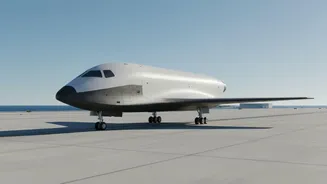
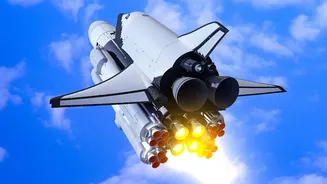
Meet Pushpak: India’s Space Shuttle
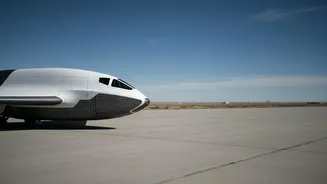
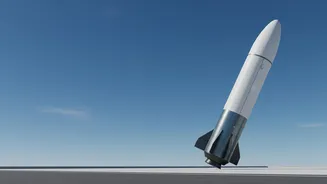
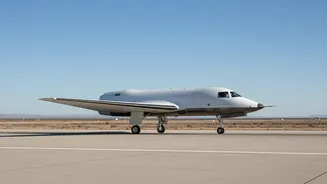
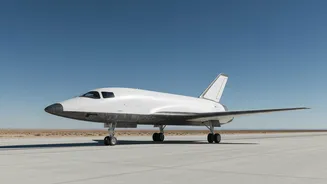
At the heart of India's quest for affordable space access is the Reusable Launch Vehicle (RLV), affectionately named 'Pushpak'. This winged vehicle is the cornerstone of a technology demonstration program designed to master the art of bringing a spacecraft
back from orbit and landing it like an airplane. In a series of crucial tests known as the Landing Experiment (LEX), ISRO has successfully demonstrated Pushpak's ability to land autonomously. The most recent test, LEX-03, saw the vehicle dropped from an Indian Air Force Chinook helicopter at an altitude of 4.5 km. From there, Pushpak navigated itself under challenging wind conditions to a precise, high-speed landing on a runway at the Aeronautical Test Range in Chitradurga, Karnataka. The vehicle landed at over 320 kmph, faster than a typical fighter jet, proving the robustness of its guidance, navigation, and control systems.
The Core Idea: Reusability Equals Affordability
Imagine an airline having to build a brand new aircraft for every single flight. Air travel would be impossibly expensive. For decades, that is exactly how space launches have worked. Rockets, which cost hundreds of crores to build, are discarded after a single mission. The most expensive components, particularly the first stage with its powerful engines and complex avionics, make up 60-80% of the total cost. Reusable Launch Vehicles change this paradigm completely. By recovering and reusing the most valuable parts of the rocket, the cost per launch plummets. This is the fundamental principle behind Pushpak. The goal is to create a system where the launch vehicle can fly to space, deploy its payload (like satellites), re-enter the atmosphere, and land on a runway, ready to be refurbished for another mission.
Slashing Costs for a Competitive Edge
The economic implications of mastering RLV technology are immense. By moving away from the 'use-and-throw' model, ISRO aims to reduce the cost of placing a kilogram of payload into Low Earth Orbit by a significant margin. Some estimates suggest that reusable technology could cut launch costs by as much as 80%. This dramatic cost reduction is not just about saving money; it is a strategic move to capture a larger share of the burgeoning global commercial satellite launch market. Lower launch prices make India an attractive option for domestic and international companies looking to deploy satellite constellations for communication, earth observation, and other services. This capability directly enhances India's competitiveness against established players like SpaceX, which has already demonstrated the economic viability of its reusable Falcon 9 rockets.
A 'Hat-Trick' of Success and the Road Ahead
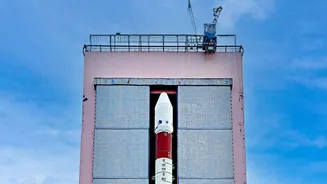
ISRO has declared a 'hat-trick' with the successful completion of three consecutive landing experiments (LEX-01, LEX-02, and LEX-03). A significant achievement in the latest tests was the reuse of the winged body and flight systems from the previous mission without any modifications, proving the design's robustness. While these landing tests are a critical milestone, Pushpak is still a technology demonstrator. The next major step is the Orbital Re-entry Experiment (ORE). This will involve launching the vehicle into orbit on a rocket, after which it will de-orbit, survive the intense heat of re-entry, and perform an autonomous landing. Mastering this phase is essential before the technology can be integrated into a fully operational, two-stage-to-orbit launch vehicle that can serve the commercial market.