


Meet the 'Roman' Telescope
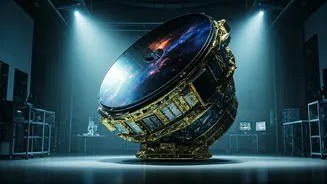
Often, big science comes with big price tags, and the Nancy Grace Roman Space Telescope is no exception. Named after NASA's first chief of astronomy, this next-generation observatory is currently in its final stages of assembly. Unlike its famous predecessors,
Hubble and Webb, which focus on tiny patches of the sky with extreme detail, Roman is designed to be a great cosmic surveyor. Its primary mission is to capture enormous, panoramic images of the universe, helping scientists tackle two of the biggest mysteries in cosmology: dark energy and dark matter. It’s not just a new telescope; it's a new kind of eye on the cosmos, designed for scale and statistical power.
What a $4.3 Billion Telescope Buys
The $4.3 billion figure isn't just for the hardware; it's a lifecycle cost covering design, development, launch, and five years of operations. So, where does the money go? It funds a primary mirror the same size as Hubble's (2.4 meters) but with a field of view 100 times wider. It also pays for two state-of-the-art instruments: the Wide Field Instrument (WFI), which will map the cosmos, and a sophisticated Coronagraph Instrument, a technology demonstration designed to directly image exoplanets. Building instruments that can withstand a rocket launch and operate flawlessly in the vacuum of space, millions of kilometres from Earth, is an extraordinarily complex and expensive engineering challenge.
Not Just Another Webb or Hubble
It’s easy to get telescope fatigue, but Roman is fundamentally different from what has come before. Think of it this way: if the Hubble and Webb telescopes are like microscopes, allowing us to zoom in on a single ant with incredible clarity, the Roman telescope is like a high-resolution satellite camera, capable of imaging the entire city in one shot. Its Wide Field Instrument will generate more data than any previous NASA astrophysics mission. In its first five years, Roman is expected to image 50 times more sky than Hubble has in over 30 years, creating a treasure trove of data that will keep astronomers busy for decades.
Hunting Cosmic Ghosts
Roman has two primary objectives. The first is to hunt for the elusive forces of dark energy and dark matter, which together are believed to make up 95% of the universe. By mapping the distribution of millions of galaxies across space and time, scientists can study how the expansion of the universe has accelerated, giving us our best clues yet about the nature of dark energy. The second objective is to conduct a massive census of exoplanets—planets orbiting other stars. Roman is expected to discover thousands of new exoplanets, from gas giants to rocky worlds, helping us understand how common planetary systems like our own are in the galaxy.
A New Way to See Alien Worlds
Perhaps Roman's most futuristic feature is its Coronagraph Instrument. This is a high-risk, high-reward technology demonstrator designed to do something incredibly difficult: block the overwhelming glare from a star to take a direct picture of a faint planet orbiting it. While the Kepler telescope found planets by watching for the dip in a star's light as a planet passed in front, the coronagraph will aim to see the planet itself. If successful, this technology will be a game-changer, paving the way for future missions that could one day scan the atmospheres of Earth-like planets for signs of life.
The Final Assembly and Launch
As of early 2024, the telescope's components are coming together at various NASA centers and partner facilities. The complex instruments are being integrated and subjected to rigorous testing to ensure they can survive the journey to space. The telescope's core components are being prepared for the final assembly phase. While delays in big space projects are common, NASA is targeting a launch no later than May 2027. Once launched, it will travel to the second Lagrange point (L2), about 1.5 million kilometres from Earth, the same cosmic neighbourhood where the James Webb Space Telescope resides, to begin its five-year mission.