




A Sweet Discovery in a Harsh Place
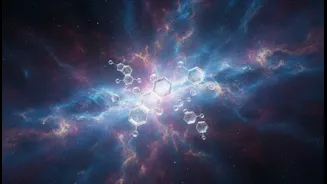
An international team of astronomers has detected the first true sugar molecule in the interstellar medium, the vast, cold space between stars. Using powerful radio telescopes in Spain, they identified erythrulose, a four-carbon sugar, in a molecular
cloud named G+0.693-0.027, located roughly 27,000 light-years from Earth near the Milky Way's core. On Earth, this same sugar is found in raspberries and even used in some sunless tanning products. Finding it in the frigid, near-vacuum of space is a landmark achievement. While sugar-like molecules had been found on asteroids and meteorites before, this is the first direct detection of a complex sugar floating freely in the cosmic dust and gas from which stars and planets are born.
More Than Just Sugar
Sugars are fundamental to life as we know it. They form the structural backbone of RNA and DNA, the molecules that carry genetic instructions, and are crucial for metabolic processes that provide energy to cells. For decades, a major puzzle in origin-of-life research has been how these essential sugars first formed on early Earth, as lab experiments simulating prebiotic conditions have struggled to produce them in significant quantities. The discovery of erythrulose in space provides a compelling alternative. It suggests that these key ingredients didn't necessarily have to form on Earth; they could have been created in space and delivered to our young planet via comets and asteroids during the Late Heavy Bombardment about four billion years ago. Researchers estimate that millions of tonnes of this sugar could have reached Earth's surface, contributing to the primordial chemical soup from which life emerged.
Rewriting the Planetary Cookbook
This discovery fundamentally alters our understanding of cosmic chemistry. The prevailing theory was that complex organic molecules in space form sequentially, with smaller molecules adding carbon atoms one by one to grow larger. However, the team that found erythrulose also noted it was at least eight times more abundant than similar three-carbon sugars in the same region. This unexpected finding suggests a different formation pathway. Instead of a slow, step-by-step growth, it seems erythrulose may form from the combination of two simpler, two-carbon molecules that are already known to be plentiful in space. This implies that the chemical factory of the interstellar medium is more efficient and capable of producing complex structures more directly than previously assumed. These molecular clouds are the very nurseries where new stars and their planetary systems form, meaning these complex sugars are available ingredients from the very beginning.
A New Path for Planet Hunters
The confirmation of erythrulose in interstellar space is a game-changer for how we analyze the potential for life beyond Earth. It demonstrates that the raw materials for prebiotic chemistry are not a rare occurrence but are likely common throughout the galaxy. If complex sugars can form in the cold dust clouds between stars, then any new planetary system forming from such a cloud has access to these crucial building blocks. This dramatically expands the possibilities for where and how life could begin. For astronomers and astrobiologists, the search is no longer just for water or simple carbon compounds. This discovery opens the door to looking for other, even more complex sugars like ribose—a key component of RNA. The presence of these molecules serves as a new signpost, pointing to regions of space that might have the right ingredients to seed life on other worlds.