




The Age-Old Navigational Puzzle
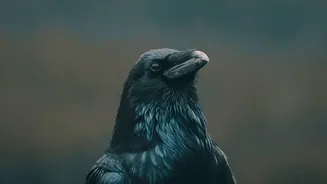
For centuries, scientists have marvelled at the navigational abilities of migratory birds. While we’ve long known they use cues like the sun, stars, and landmarks, these alone couldn't explain their unerring accuracy, especially for young birds travelling
alone at night for the first time. Another piece of the puzzle was missing. It became clear that birds possessed a mysterious 'sixth sense' allowing them to detect Earth's magnetic field. The big question was, how? A simple internal compass made of magnetic material, like iron, was one early idea, but the evidence didn't quite fit. For instance, experiments showed that the birds' magnetic sense depended on light, which a simple iron-based compass would not.
A Quantum Leap in Understanding
The leading explanation today is a mind-bending theory called the Radical-Pair Mechanism. It suggests that the secret to the avian compass lies in a quantum process happening inside the bird's own eyes. This isn't science fiction; it's a field known as quantum biology, which explores how quantum mechanical effects can influence living organisms. At the heart of this theory is a specific light-sensitive protein found in the retinas of birds called cryptochrome. When light strikes this protein, it triggers a chemical reaction that is exquisitely sensitive to magnetic fields, even one as weak as Earth's.
How Birds 'See' the Field
Here's how it is believed to work: when a photon of blue light hits a cryptochrome molecule in the bird's retina, it causes an electron to jump from one part of the molecule to another. This creates a 'radical pair' — two molecules that now each have an unpaired electron. These two electrons are quantum-linked, or 'entangled', meaning their properties are connected. Their orientation, or 'spin', oscillates between two different states. Crucially, the Earth's magnetic field can influence how long the electrons stay in one state versus the other. The angle of the magnetic field lines relative to the bird's head changes the outcome of this chemical reaction.
From Quantum State to Visual Pattern
This quantum process doesn't give the bird a 'feeling' of magnetism. Instead, it's believed to generate a visual pattern that is superimposed over the bird's normal field of vision. The varying chemical reactions across the retina, depending on how the cryptochromes are aligned with the magnetic field, could create spots of light or shade. In effect, the bird might literally see the Earth's magnetic field as a pattern. This pattern would change as the bird turns its head, giving it a real-time, visual compass to stay on course. Neurological studies have identified a specific brain region in birds, known as Cluster N, that processes this magnetic information received from the eyes.
The Mounting Evidence
While still a theory, the evidence for the Radical-Pair Mechanism is compelling. Scientists have found that the cryptochrome protein in migratory birds, like European robins, is more magnetically sensitive than in non-migratory birds like chickens. Furthermore, behavioural experiments have shown that birds' ability to orient themselves can be disrupted by specific frequencies of weak, oscillating magnetic fields — a result predicted by quantum theory that is hard to explain otherwise. These experiments strongly suggest that the quantum coherence of radical pairs is not just a theoretical possibility but a biological reality that birds have harnessed for navigation.