








A Major Policy Shift
The foundation for this explosive growth is a fundamental change in policy. The Indian Space Policy 2023 officially opened the doors for private companies, or Non-Government Entities (NGEs), to participate in end-to-end space activities. This isn't just
a minor tweak; it's a structural overhaul. The policy clarifies the roles of different bodies: ISRO will focus on advanced research and development, NewSpace India Limited (NSIL) will handle the commercialisation of ISRO's technologies, and the Indian National Space Promotion and Authorisation Centre (IN-SPACe) will act as a single-window agency to authorise and support private sector activities. This has unleashed a wave of entrepreneurship, with the number of space startups growing from just one in 2014 to over 440 by mid-2026.
Upstream: Building the Rockets and Satellites
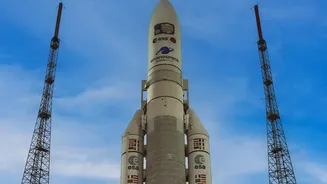
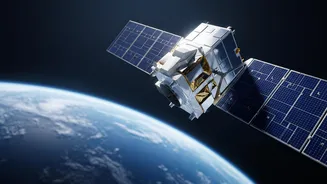
The upstream sector involves the actual manufacturing of space hardware. This includes building launch vehicles (rockets), satellites, and the crucial ground systems needed to support them. Traditionally ISRO's domain, private companies are now entering this space in a big way. For instance, companies like Larsen & Toubro are involved in building ISRO's workhorse PSLV rockets. Startups like Skyroot Aerospace and AgniKul Cosmos are developing their own private launch vehicles. A significant opportunity lies in small satellite manufacturing, where India aims to become a global hub. Liberalised Foreign Direct Investment (FDI) rules, allowing up to 74% in satellite manufacturing and 49% in launch vehicles, are set to attract more global capital and expertise into building this industrial base.
Downstream: Where the Real Value Lies
While rockets capture the imagination, the biggest economic opportunity lies in the downstream sector. This segment is all about the services and applications that use data from satellites and is expected to generate the majority of future revenue. Experts project that satellite-enabled services could account for over $32 billion of the $44 billion market by 2033. This includes Earth Observation (EO), Satellite Communication (SATCOM), and Positioning, Navigation, and Timing (PNT) services. These applications have a vast impact on the wider economy, supporting everything from agriculture and disaster management to urban planning, logistics, and climate resilience. Think improved crop yield estimates, better weather forecasting, enhanced tele-education and tele-medicine for remote areas, and more efficient infrastructure project monitoring.
The Startup and Innovation Ecosystem
The rapid growth of India's space economy is being powered by a dynamic startup ecosystem. With private investment surging nearly six-fold between 2022 and 2026, these companies are innovating across the value chain. Some are focused on building new launch vehicles, while others are developing satellite constellations for high-resolution imaging or communication. Dhruva Space, for example, is building one of India's largest satellite manufacturing facilities in Hyderabad. IN-SPACe plays a critical role here, not just by providing authorisations but also by facilitating the transfer of mature technologies from ISRO to the private sector, giving startups a running start. This public-private partnership model allows ISRO to focus on next-generation challenges like manned missions and deep space exploration while the private sector drives commercialisation.