




The Junkyard Above Our Heads
Imagine a highway where cars travel at over 28,000 kilometres per hour, and the lanes are littered with discarded parts, paint flecks, and entire dead vehicles from decades of use. That’s the reality in low-Earth orbit (LEO), the vital orbital band that
hosts the International Space Station and thousands of satellites essential for communication, navigation, and climate monitoring. As of early 2026, the European Space Agency was tracking over 44,000 pieces of debris, a number that has grown dramatically in recent years. The bigger concern is the estimated 140 million smaller, untrackable pieces that can still cause catastrophic damage. This growing cloud of space junk poses a direct threat to the multi-billion dollar space economy and increases the risk of a chain reaction of collisions, known as the Kessler Syndrome, that could render parts of orbit unusable for generations.
The Challenge of Taking Out the Trash
Cleaning up space is not as simple as sending up a cosmic garbage truck. Proposed solutions have ranged from the complex to the futuristic, including giant nets, harpoons, and even lasers. Most of these concepts face a fundamental challenge: they require vast amounts of propellant to chase down and de-orbit each piece of debris, making them incredibly expensive and complex. For a satellite operator, this means adding significant mass and cost to a satellite just for its end-of-life disposal. As the number of satellites in mega-constellations like Starlink continues to grow, the need for a more efficient and scalable solution has become urgent. Any effective technology must be lightweight, reliable, and, most importantly, not require its own large fuel tank to operate.
A Magnetic Solution Emerges
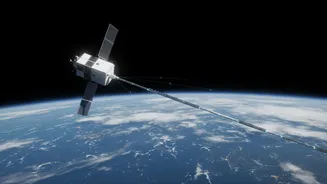
Enter the electrodynamic tether. The concept, which dates back decades, is elegant in its simplicity. It involves unfurling a long, thin, conductive wire—sometimes just a few centimetres wide but potentially kilometres long—from a satellite. As this tether moves through the Earth's magnetic field, it naturally generates an electric current by interacting with the plasma in the upper atmosphere. This current, in turn, creates an electromagnetic force known as Lorentz drag. This drag acts like a brake, slowing the satellite down without using a single drop of propellant. As the satellite slows, its orbit decays, causing it to descend until it safely burns up in the Earth's atmosphere. This passive, propellant-free system is a game-changer for post-mission disposal.
From Theory to Commercial Reality
The "breakthrough" is the transition of this technology from academic theory and early experiments to commercially viable products. Companies and agencies are now moving forward with real-world demonstration missions. The European Space Agency is supporting startups like PERSEI Space, which plans a major demo mission in 2026 to test its fuel-free de-orbiting system. Similarly, a consortium including Astroscale France and Thales Alenia Space is working on a project called ECO-Tethers to mature the technology. These systems are being designed to be small and light enough to be attached to satellites before launch, offering a built-in, low-cost disposal method. This shift is driven by a growing commercial demand from satellite operators who need to protect their valuable assets and comply with emerging regulations aimed at ensuring the long-term sustainability of space.
The Business of a Cleaner Orbit
The commercial case for magnetic tethers is clear. For operators of large satellite constellations, they offer a low-mass, low-cost way to de-orbit satellites at the end of their life, preventing them from becoming future hazards. This is not just about being a good corporate citizen; it's about risk management. The cost of losing a multi-million dollar satellite to a debris collision far outweighs the cost of integrating a de-orbiting device. Some designs even propose that the energy generated by the tether during de-orbit could be harvested and used, adding further value. Companies like Tethers Unlimited, Starfish Space, and others are developing a suite of technologies around this concept, from the tethers themselves to the complex autonomous software needed to operate them safely, signalling a new market focused on in-orbit services and sustainability.