





The Challenge of Seeing the Unseen
Characterising the atmosphere of an exoplanet—a planet orbiting a star outside our solar system—is one of modern astronomy's most significant challenges. These worlds are incredibly faint and extraordinarily far away. Directly imaging them is nearly impossible
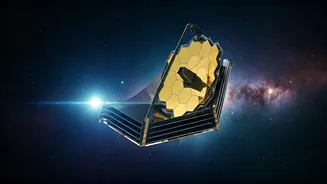
with current technology. Instead, scientists rely on a clever trick called transit spectroscopy. When an exoplanet passes in front of its host star from our perspective, a tiny fraction of the starlight filters through the planet’s atmosphere. By analysing this light with powerful instruments like the James Webb Space Telescope (JWST), astronomers can look for the chemical fingerprints left behind by different molecules. Each element or molecule absorbs light at a specific wavelength, creating a unique barcode that tells scientists what the alien sky is made of. The problem is that the atmospheric layer is usually exceptionally thin compared to the size of the planet, making the signal incredibly subtle and difficult to detect.
Enter the Hot Jupiters
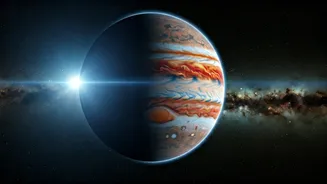
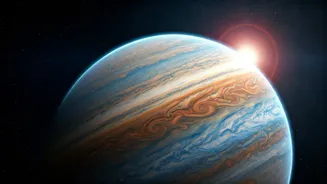
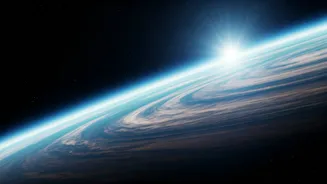
This is where extreme heat provides an unexpected advantage. Astronomers have discovered a class of exoplanets known as "hot Jupiters." These are gas giants, similar in size to our own Jupiter, but they orbit perilously close to their stars, completing a full year in just a few Earth days. This proximity bakes them to scorching temperatures, sometimes exceeding 1,700 degrees Celsius. While this makes them far from habitable, their extreme climate is a gift to astronomers. The intense heat causes the planet’s atmosphere to expand and puff up like a marshmallow held over a campfire. This dramatically increases the size of the atmosphere that starlight has to pass through during a transit, making those faint chemical fingerprints much more pronounced and easier for telescopes like the JWST to read.
A Window into Alien Weather
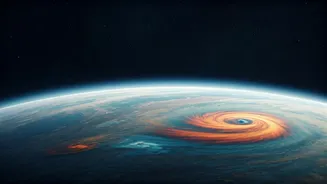
A puffed-up atmosphere isn't the only benefit of the intense heat. Many hot Jupiters are tidally locked, meaning one side permanently faces the star in perpetual, blistering daylight, while the other side is locked in constant night. This massive temperature difference between the day and night sides can drive supersonic winds that whip around the planet. These powerful winds can dredge up materials from deeper inside the planet's atmosphere and circulate them, offering scientists a glimpse into chemical processes that would otherwise remain hidden. Recent observations of one such planet, WASP-17b, used the JWST to detect tiny crystals of quartz in its high-altitude clouds, a discovery made possible by its hot, puffy nature. On another extreme world, HD 80606 b, the telescope watched the temperature jump by about 600°C as it swung close to its star, allowing scientists to study how its atmospheric chemistry responds to the sudden roasting in real time.
Decoding the Chemical Clues
Thanks to these bloated, superheated atmospheres, scientists are successfully identifying a range of molecules that are crucial for understanding planetary formation and composition. Using transit spectroscopy, they have confirmed the presence of water vapour, methane, carbon dioxide, and even more exotic substances like silicon dioxide (quartz). Finding and measuring these gases helps astronomers piece together the story of how these planets formed and evolved. It allows them to test and refine their atmospheric models. By studying these extreme cases, where the physical and chemical processes are magnified, they can build more robust theories that can later be applied to less extreme worlds. Every hot Jupiter becomes a natural laboratory, providing data that sharpens our understanding of planetary science as a whole.
A Stepping Stone to Finding Earth 2.0
While hot Jupiters themselves are not candidates for life as we know it, studying them is a critical step on the path to finding a truly Earth-like world. The techniques and models perfected by observing these scorching giants will be essential for analysing the much fainter signals from smaller, cooler, rocky planets that might lie in their star’s habitable zone. By understanding the tell-tale signs of different atmospheric compositions in extreme environments, scientists will be better equipped to spot the unique combination of gases that could indicate a habitable, or even inhabited, world. In the grand search for alien life, these inhospitable, fiery worlds are paradoxically lighting the way forward.